

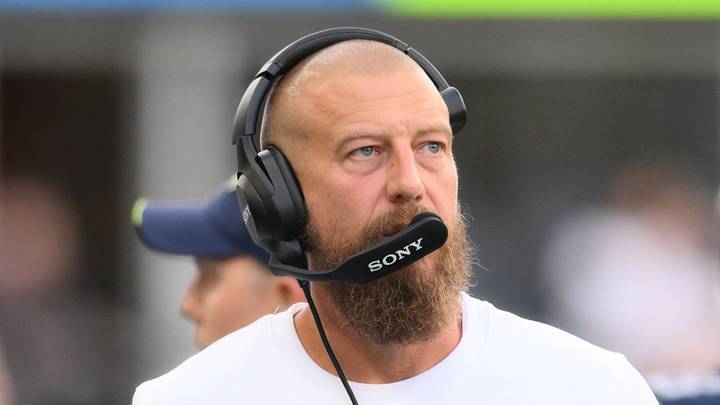
The Seattle Seahawks ran 48 offensive plays against the New England Patriots in the 2026 season -opening game. The Patriots ran 67. Seattle is not supposed to win a game with those numbers, and are just one of several things that must be addressed before Week 2.
They did have a few wins last year with fewer than fifty plays. But those were against fairly anemic opponents like Washington and Tennessee. Seattle hit on plenty of big plays and scored lots of points in those games. Against a much stingier Patriots’ defense, having so few plays should have cost them the win.
It didn’t – primarily because the defense took over in crunch time. Three fourth quarter interceptions turned a likely loss into a very impressive win. With starting quarterback Sam Darnold missing all but five plays, the defense had to step up. It is very reassuring to know that they can bail the team out when necessary.
Three things the Seattle Seahawks must fix before Week 2
It is not entirely fair to blame Seattle’s offense for the problems they encountered on Wednesday. Losing your starting QB early is pretty much the biggest obstacle any team can face. It may well change the entire game plan and diminish confidence. Still, every NFL coach knows this is the reality of the league. You get no sympathy when you lose a quarterback. You simply have to move forward.
Whether Darnold is back for Week 2 or not, here are the things Seattle must do in order to move forward.
Third-down efficiency
Two-for-eleven on third down is not going to win you many games. This was Brian Fleury’s first game as an offensive coordinator and play caller, and by a few key metrics, he did very well. The Seahawks had a nice run/pass balance. They averaged 5.9 yards per play, even without Darnold. But third downs almost spoiled the night. That is the biggest reason for the scant number of plays.
And the biggest reason for the failure to convert wasn’t necessarily the play-calling on third down. It was the lead-up to that third down. The average distance Seattle needed to convert on their eleven third-down tries was just under seven yards. That is a tall order. That number was inflated by one outlier, but even if you remove it, the Hawks still needed more than five yards on average to convert.
Fleury will obviously have to come up with some new third-down strategies – Seattle failed to convert the two third-and-short situations they faced. (They did pretty well on their one fourth-and-short, however.) The third-down numbers will benefit from addressing another obvious problem in Week 1.
Penalties
Ten penalties for 98 yards. Seven of those flags came on offense. That was a major cause of the poor third-down stats.
Every single offensive penalty was the result of sloppiness or lack of concentration. Seattle’s players were never beaten physically. They didn’t have to hold to keep a defender from overpowering them. The penalties were false starts, illegal shifts, and delay of game. One wiped out a first down. Another, a touchdown.
These are all operational issues, and you have to wonder how much having a backup QB on the field mattered. Lock was reading plays off his wristband throughout the game. His cadence is different from Darnold's, and that could have been an issue. Fleury appeared to get plays in late on a few occasions.
The good news is that all those things can and should be worked out before Week 2. If you watched the Seahawks on Hard Knocks this season, you know that a lot of what Macdonald and his coaches focus on early in camp is the procedure.
Moving in and out of huddles with pace. Getting lined up properly. These are things that might seem second nature to fans, but they need to be drilled just like anything else. I expect the Seahawks will be doing quite a bit of work on that next week.
Red zone
Penalties hurt in the red zone. An illegal shift wiped out a touchdown. A delay of game took away another golden opportunity. Nevertheless, the Seahawks still ran red zone plays – several from inside the 10-yard-line, and failed to find the end zone.
They tried running early and did not have success. They tried passing late and also came up empty. With the field compressed, red zone offense cannot simply mirror what has worked in the middle of the field. Lock threw three times for Smith-Njigba from inside the ten and couldn’t connect.
Of course it makes sense to use your best player in those situations. But don’t be surprised if JSN is employed as a decoy in the coming weeks. Look for tight ends to become more prominent red-zone targets as soon as Week 2.
Coaches, players, and fans are all very happy to get a win over a quality opponent in Week1. But let’s remember that Seattle actually lost in Week 1 last year. They learned from that and grew. Even though this year began with a win, they need to treat it the same way they treated the opening-day loss last year – identify the problems and make swift corrections.
 Add us as a preferred source on Google