

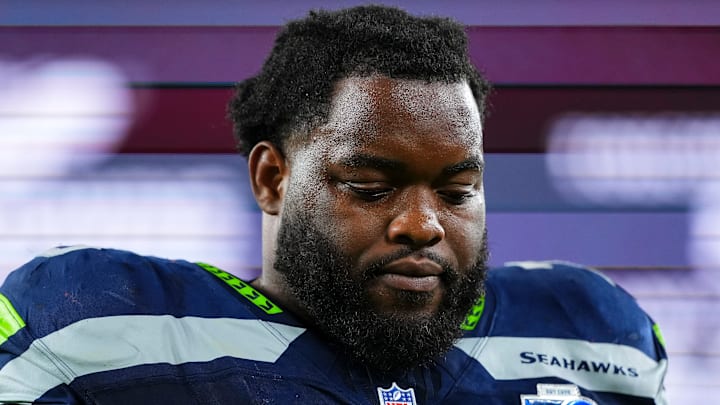
It’s not as if a two-point road loss to the Los Angeles Rams is a “sky is falling” moment for the Seattle Seahawks. Mike Macdonald still has a very good team that should make it into the postseason for the first time since 2022. Once there, the Hawks’ outstanding defense and potentially explosive offense should make them a formidable opponent.
That offense is experiencing its first real turmoil since the opening day loss to the San Francisco 49ers. It comes on three fronts.
The most obvious one comes in the form of Sam Darnold’s four interceptions against LA. No one is going to argue that it is not a major problem. The fact that Darnold’s last performance against the Rams resulted in nine sacks and a pick only adds to the questions about whether he can perform against the best in the league.
Should the Seattle Seahawks consider making changes to their offensive line?
A second concern, which to me is more important than Darnold’s poor night last Sunday, is Seattle’s inability to produce in the red zone. Seattle was dreadful against the Rams. They moved the ball quite well in the middle of the field but had no answers in the red zone, continually settling for short field goals. That, at least as much as the interceptions, cost them the game.
Then there is a third issue, which is related to the first two and which may prompt some adjustments to the depth chart.
Through the first eight weeks of the season, the Seahawks’ offensive line remains intact. Offensive line cohesiveness is one of the sneaky markers of success or failure in the NFL. Good rosters are designed to withstand an injury to a lineman. That is just the cost of doing business in the NFL.
A second injury can really begin to stress productivity. It’s the rare team that can survive the extended loss of more than two linemen in a season.
Credit Sam Darnold and Jaxon Smith-Njigba. Credit Klint Kubiak and a defense that is gaining comfort in Macdonald’s system. They have all been major factors in Seattle’s success this year. But don’t ignore the health of the offensive line. In 2024, the Hawks had revolving doors at both right guard and right tackle, and they watched incredulously as their starting center retired mid-season.
Until the last few weeks, they have been relatively lucky this year.
Then, center Jalen Sundell went down against Arizona. A week later, college teammate Grey Zabel was hurt in the Rams game. Losing two interior line starters in consecutive weeks is an obvious challenge.
Fortunately, it appears that Zabel’s injury is not terribly serious. It is unknown at this point whether he will miss time, but hopefully, even if he does, it will be limited.
And Seattle does have two prominent players from 2024 – center Olu Oluwatimi and guard Christian Haynes – available to step in. Haynes played on the right side last year, but he seems reasonably comfortable moving to the left.
If Haynes performs well in relief of Zabel, it may present Macdonald, Kubiak, and offensive line coach John Benton with an interesting decision. Right guard Anthony Bradford has been perceived as the weak link on the line this season. I think that is an overstatement. Bradford has certain skills that make him very useful in particular situations. But he has deficiencies as well.
Bradford is a powerful drive blocker. I think he is probably a better straight-ahead power blocker than the highly touted Zabel. And if you check their Pro Football Focus grades (subscription required), that seems to check out. But he is not very nimble and struggles – sometimes mightily – in pass protection.
Zabel, whose PFF score is surprisingly low, is a more polished player, despite being a rookie. He entered the league with a very sound pass blocking technique, which is rare for such a young player. He is not yet a dominant run blocker, but everyone expects that it will come in time.
Zabel, if healthy, is not ceding the left guard spot to anyone. But if Bradford continues to struggle in pass protection and if Haynes looks good in his audition at left guard, would the Hawks consider a change?
That would leave them with a center/right guard combo of Oluwatimi and Haynes. Both played last year, though not together. Bradford, when healthy, was the coaches' choice over Haynes in 2024, and they turned to another rookie, Sataoa Laumea, ahead of Haynes when Bradford was injured. (Laumea is not currently on an NFL roster.)
So the question becomes this. Has Christian Haynes progressed enough in his second year to take over a starting spot on a playoff contender’s line? Can he help keep pressure off Sam Darnold better than Bradford, while also allowing Seattle to run the ball effectively?
There was some thought that Kubiak’s zone-heavy schemes would suit Haynes better than the offense Ryan Grubb ran last season. Haynes has always moved well for a big man.
It bears watching. The fact is, despite its troubles against the Rams, Seattle still managed to put up 414 yards of total offense. Even with the change at center, the Hawks ran for 135 yards. Their 3.9 yards-per-carry wasn’t very good, but it was actually better than their average entering the game.
Making crucial changes at this point in the season might actually backfire. Sundell is probably out for a while. So does it make sense to simply allow Oluwatimi to develop rapport with four other linemen who have been on the field for almost every snap this season? Or does it make sense to try the talented-but-as-yet-unproven Haynes to see if he can increase overall production?
I think this decision is part of a more important question concerning the red zone offense. Seattle is going to move the ball up and down the field regardless of which right guard they choose. Will their red zone offense be more effective with Bradford or Haynes on the field? That is what should determine the answer to the depth chart question.
 Add us as a preferred source on Google