

One of the truly maddening things about professional football is that the most important position on the field has proven to be the most difficult to scout. Sure, the Seattle Seahawks (and every other team) miss all the time on a defensive tackle or wide receiver, but you don’t find nearly as many massive failures at those positions as you find at quarterback.
I suppose the very importance of the position plays into this problem. Teams – especially teams that have endured many years of mediocre play from the field general – are so desperate to find the elusive franchise QB that they talk themselves into things.
They talk themselves into believing that Bryce Young’s size or Kenny Pickett’s arm are minor issues that can be overcome by genius scheming.
Note to general managers. They can’t. Of course, quarterbacks can be developed, but if they have big holes in their game when they enter the league, there’s a good chance those holes will remain. They’ll probably even grow in dimension when facing NFL defenses.
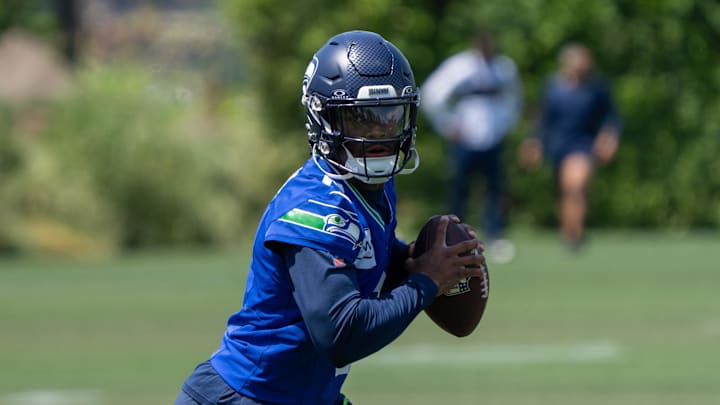
Seattle Seahawks quarterback Jalen Milroe has a long way to go
I have been preaching this since the draft. Barring multiple injuries, Jalen Milroe should not be in the conversation for starting at any point this season. That doesn’t mean he shouldn’t play. That doesn’t mean he won’t eventually be a better quarterback than both players ahead of him on the depth chart.
It just means that a young, inexperienced quarterback should not be thrown to the wolves before he has adjusted to all the complexities of playing QB in the NFL.
It would be foolish to expect that of Milroe, who at times had trouble with decision-making and accuracy in college. He is a spectacular runner and has a very good arm. In many ways, he reminds me of Justin Fields. A little faster and not quite as powerful, but still a quarterback who is usually at his best when he is a threat to run the ball.
If anything, Fields was a more accurate passer in college, and that is a problem. Fields has proven to be far less accurate in the pros. Playing at Ohio State, with NFL-caliber receivers and linemen, Fields looked sensational. Playing without a huge talent advantage, he has struggled.
If Milroe were forced into the starter’s role for Seattle this year, that is exactly what he would face. He would not have the type of advantage he often enjoyed in Alabama. His decision making and accuracy would be sorely tested. So far in training camp, he has made a number of good throws and has looked good operating RPOs. But he has also made enough shaky plays to remind everyone of how far he has to go.
Klint Kubiak needs a plan for Milroe. He should be active every week and should get on the field in some tailor-made moments, running a limited series of plays that have been designed for him.
Early on, these plays should be options in which he has to make one read in the passing game, and take off running if what he wants isn’t there. That is how you slowly get Milroe acclimated to the speed and physicality of Sundays in the NFL.
Eventually, you give him more traditional dropbacks and more complex route trees. But that only comes over time.
I was not a fan of the Milroe pick, but he clearly possesses as much upside as any QB in the 2025 draft. Maybe more than any other QB. John Schneider had a lot of picks this year, and getting Milroe in the third round – after picking three likely starters ahead of him – constitutes a pretty good risk to take.
Like any fan, now that he’s here, I want to see him flourish. In a counterintuitive way, having him struggle a bit in practice may turn out to be a good thing. It may put to rest any clamoring from the fanbase to play him before his ready
More Seahawks news and analysis:
 Add us as a preferred source on Google