

For a team that has undergone significant turnover in the last two years, the Seattle Seahawks are preparing to enter OTAs with a lot of their projected starters in place. On defense, there is very little change from the unit that closed out the 2024 season on a positive note.
DeMarcus Lawrence slots into the spot manned by underachieving Dre’Mont Jones and should constitute an upgrade. Draft pick Nick Emmanwori figures to play all over the field. Otherwise, things should look a lot like last year.
On offense, there has been more turnover, and there are many new draft picks to evaluate. Most importantly, a new offensive coordinator brings a different scheme. That undoubtedly will lead to changes in the way personnel are deployed. However, although we cannot know precisely how it will all shake out, certain one-for-one replacements seem likely.
Geno Smith out – Sam Darnold in. DK Metcalf and Tyler Lockett gone – Cooper Kupp and Marquez Valdes-Scantling arrived. Good-bye to Laken Tomlinson – hello to Grey Zabel. But there are still a lot of key battles to be fought out this offseason. One of them involves a relatively new position for the Seahawks.
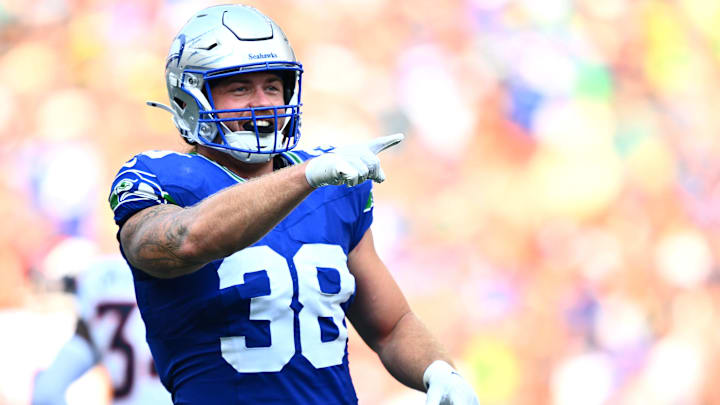
Who will be the Seahawks fullback in 2025?
When he served as offensive coordinator with the Vikings in 2021, Klint Kubiak employed a fullback on roughly one-third of Minnesota’s offensive snaps. That player, C.J. Ham, was a veritable bowling ball of a player.
Under 6-feet tall and weighing in at about 250 pounds, Ham served as a devastating lead blocker for Dalvin Cook and Alexander Mattison. The Viking tailbacks ran for 1,650 yards and over 4.3 yards per rush.
Ham barely carried the ball, but he caught 17 of his 18 pass targets on the year was usually good for an important play in each game.
After leaving Minnesota, Kubiak served on Kyle Shanahan’s staff in San Francisco, where he got an up-close look at Kyle Juszczyk, arguably the most productive fullback in the league. He played roughly half of the 49ers' snaps and was involved as a blocker, runner, and receiver.
Last year in New Orleans, Kubiak once again used a classic blocking back: Adam Prentice. The Saints’ offense was decimated by injuries throughout the season, but Prentice still played for about one-quarter of the offensive snaps.
It seems likely that Kubiak will use a similar player now that he has taken charge of Seattle’s offense. He probably has the blessing of head coach Mike Macdonald, who also witnessed the benefits of having a big bruiser in the backfield while coaching with the Ravens. At 300 pounds, Baltimore’s Patrick Ricard is the biggest regular fullback in league history.
This explains why John Schneider surprised many analysts by selecting Alabama tight end Robbie Ouzts in the fifth round of the 2025 draft. Ouzts caught very few passes at Alabama, but was an outstanding blocker.
He typically lined up as a traditional inline tight end or as a wing, off the line just outside the tackle. From there, he could be a lead blocker on running plays and slip into pass patterns when needed.
This is essentially the same position that 2023 UDFA Brady Russell has been groomed for. Though it is certainly possible that the Hawks could keep both on their 53-man roster, I would not bet on it. There will probably be direct competition between the two players for one spot, with the other player going to the practice squad.
We’ll know much more when we see them on the field, but a few things already seem obvious. Russell is faster and more agile. At this stage, he is probably a better receiver and has been a very good special teams performer in his short career.
Ouzts is bigger and stronger. He already shows signs of being a polished blocker who can stand up against linemen and get out into space against more undersized linebackers at defensive backs on sweeps and pulls.
The fact that both players are converted tight ends offers no real tea leaves to read. Of the four fullbacks mentioned earlier, only Juszczyk was a college tight end. Ham was an all-purpose tailback. Prentice was a pure fullback. And Ricard played defensive line.
Modern fullbacks can come from virtually anywhere. Russell and Ouzts played tight end in college, which suggests they are skilled at running pass patterns.
The common assumption is that this is Ouzts’ job to lose. Teams rarely spend a fifth-round pick on a niche player if they don’t think he will be a contributor. However, he still has to prove it on the field. After quarterback and center, tight end may be the most challenging position to learn in a professional offense.
Because of the dual nature of the position, tight ends have to read defenses and make quick decisions about who to block and when to run patterns. Russell’s experience could give him a leg up.
We’ll see this play out beginning in OTAs. I find it highly unlikely that both players make the final roster. I have heard it suggested that if Russell wins the battle, Seattle would be more likely to keep Ouzts on the roster because of his draft status. Stashing him away on the practice squad risks losing him to another team. But I’m not sure that is true.
Many draft analysts considered Ouzts a UDFA. That has more to do with his niche position and the fact that most teams do not employ a classic fullback than with his talent. There may not be many teams that see the value that Seattle sees.
Either way, it seems likely that either Robbie Ouzts or Brady Russell will play an important role in the new-look Seahawks offense in 2025, hopefully paving the way for a big year from Kenneth Walker III and providing a security blanket for Sam Darnold.
More Seahawks news and analysis:
 Add us as a preferred source on Google