

This past weekend, the Seattle Seahawks’ John Schneider presided over his 17th draft as general manager. Now, “presided” may be the wrong word to use here. Whereas the GM of an NFL team is usually the last word on all things roster-related, for much of Schneider’s tenure in Seattle, he worked in tandem with head coach Pete Carroll.
Carroll held the additional title of vice president of football operations. We may never know the exact details of every draft decision from 2010 to 2023, but it was commonly assumed that Carroll had the final say.
Schneider assumed complete control in 2024 when Carroll was released. Schneider took on the role of president of football operations, leaving no doubt as to who was making the call on all roster moves.
Within two years of the promotion, Seattle claimed their second Super Bowl title in Schneider’s tenure. That puts him in some elite company. The fact that he accomplished this with two entirely different rosters makes him unique. John Schneider was chosen as Executive of the Year in 2025 with good reason. He is clearly among the best in the NFL.
Where will Jadarian Price rank among Seattle Seahawks' John Schneider's top draft picks?
To be clear, the most impactful moves Schneider made after taking on complete control were not necessarily draft-related. Moving on from aging stars like Geno Smith, DK Metcalf, and Tyler Lockett was a crucial decision. Investing in free agent quarterback Sam Darnold was a gamble that paid off big. Best of all, Schneider hired Mike Macdonald as his head coach.
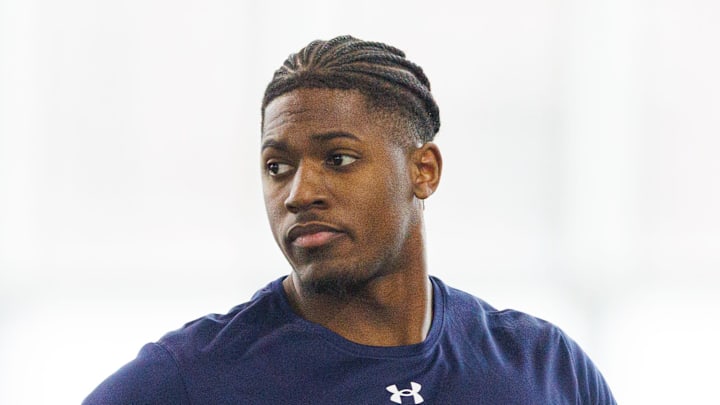
And, of course, he has made draft picks. The most recent was running back Jadarian Price of Notre Dame. Price is expected to step into the role left vacant when Super Bowl MVP Kenneth Walker III signed with Kansas City in March. If Zach Charbonnet is slow to return from his knee injury, Price could be taking on a major role from day one.
We are going to do a quick ranking of all the top picks made under John Schneider’s general managership, understanding that Carroll was intimately involved in most of the picks. Then we will project where Price may fit into the ranking.
In reverse order...
Malik McDowell, Round 2, Pick 35, defensive tackle (2017)
Schneider has made 17 “first” picks, but they have not all come in the first round. Trades have resulted in the Seahawks not having a first-round pick in five of Schneider’s draft classes. Not surprisingly, many of those second-round first picks fill out the bottom of these rankings.
McDowell was a special case. He was injured before ever playing in the NFL. Then, drug-related problems cost him virtually all of his career. He ended up playing one season in Cleveland with minimal impact.
D’Wayne Eskridge, R2, P56, wide receiver/kick returner (2021)
Another second-round top pick, Eskridge was supposed to be a dynamic slot receiver with added value as a kick returner. He was neither. Invisible as a receiver and average in kick returns, Eskridge was gone after three seasons and just 24 games for the Seahawks.
Christine Michael, R2, P62, running back (2013)
On paper, this made sense. Michael was supposed to support Marshawn Lynch for a couple of years and then take over as Seattle’s workhorse. It never worked out.
By his third year, he was outplayed by undrafted rookie Thomas Rawls. Michael was eventually traded away for a conditional seventh-round draft pick. He returned to Seattle the following year but ended his Seahawks career with fewer than 1,000 total yards in parts of four seasons.
L.J. Collier, R1, P29, defensive end, (2019)
Collier would come to be seen as the poster child for Pete Carroll’s disappearing touch with draft picks – especially defensive prospects - in the second half of his run in Seattle. Collier is the first name on our list who was, in fact, a first-round pick, which qualifies him as the worst first-rounder in the Schneider era.
He did flash some genuine talent in his second season, but proved far too inconsistent to make any kind of impact. He was gone after his rookie deal was up.
Paul Richardson, R2, P45, wide receiver (2014)
With Richardson, we move into the barely-passing-grade portion of this list. If you drafted a receiver in the sixth round and he gave you four years of modest WR3 production, you’d consider it a reasonable investment. For a second-round pick, that just wasn’t good enough.
Rashaad Penny, R1, P27, running back (2018)
I liked Rashaad Penny. He survived into a fifth season with Seattle, even though Schneider did not exercise his initial fifth-year option. It always seemed as if the San Diego State star was on the verge of finally breaking out. Indeed, his 5.7 yards per carry is the highest for any running back in team history.
Penny simply could not stay healthy. That, more than any inherent talent or dedication issue, resulted in his disappointing professional career.
Germain Ifedi, R1, P31, offensive tackle (2016)
Ifedi is a popular whipping boy for Seattle fans. He never played up to round-one pedigree, but he did take part in a lot of games at right tackle during his four seasons in Seattle, and has 90 career starts on his resume. Washouts don’t manage those numbers. He was serviceable. You obviously want more than that in a first-round pick, but let’s be honest. You could do a lot worse.
James Carpenter, R1, P25, guard (2011)
It would be easy to simply replace “Ifedi” with “Carpenter.” But really, James Carpenter was a forerunner of Anthony Bradford. He was a good run-blocking guard who was never athletic enough to be more than a mid-tier performer.
But he did start on a Super Bowl-winning team and put together a long, reasonably successful career. I suspect that one day we’ll all look back at Bradford and say pretty much the same thing.
Bruce Irvin, R1, P15, outside linebacker (2012)
We are at the midpoint of these rankings, and we come to our first truly popular player. Irvin was chosen to the all-rookie team in 2012, and he was a solid component of Seattle's great defenses in the early Pete Carroll years.
He had four very good seasons in Seattle to begin his career, then set off on a journeyman existence that took him all over the league. He even returned to the Seahawks, but had minimal impact.
Had he remained a Seahawk beyond his rookie deal, he would be higher on this list. But his fifth-year option was not exercised, which was an indication that his high-energy, at-times undisciplined style was not what Carroll wanted.
Jordyn Brooks, R1, P27, linebacker (2020)
Jordyn Brooks was a first-team All-Pro linebacker in 2025. It was as a member of the Miami Dolphins. Brooks was a very good player for Seattle – he deserved Pro Bowl recognition in his second season, when he led the NFL in solo tackles – but an ill-timed injury at the end of his third season led to him leaving for the Dolphins when his rookie deal was up.
There is no question regarding his talent, but he never seemed to be a major part of Seattle’s long-term plans.
Grey Zabel, R1, P18, guard (2025)
Maybe this is too high for Zabel, considering he has played just one season. It’s just that he showed every sign of being a fixture on an improved Seahawks line for many years to come. He solved a major problem at left guard and started on a Super Bowl-winning team. It has only been one season, and he still has room to grow, but that is a very encouraging start.
Byron Murphy II, R1, P24, defensive tackle (2924)
The blurb on Murphy is similar to the one on Zabel. In fact, Zabel’s rookie season was arguably better than Murphy’s. But the improvement from his pretty good rookie year to his sensational sophomore campaign suggests Byron Murphy will inherit the mantle of alpha on a powerful defensive front from Leonard Williams within the next year or two and will anchor one of the best defenses in the league.
Frank Clark, R2, P63, defensive end (2015)
Ranking Clark as a Seahawk is complicated by the fact that his best years came as a member of another team. Immediately upon leaving Seattle, he made three consecutive Pro Bowls and won two Super Bowls as a member of the Kansas City Chiefs.
But it isn’t as if he didn’t produce while a Seahawk. He averaged double digits in both sacks and tackles-for-loss in his final three seasons under Pete Carroll.
As the 63rd pick in the 2015 draft, Clark is also the lowest-value pick on this list, which inversely elevates how good a selection he actually was. Had he been a first-round pick, Clark’s fifth-year option almost certainly would have been exercised, and he would have remained in Seattle at least one more year – and perhaps more.
Charles Cross, R1, P9, offensive tackle (2022)
The top three players on this list just happen to be the only players chosen in the top ten of their draft classes. Probably not a coincidence. But it does show that John Schneider has done the most important thing a GM can do in any draft. He nails his highest-value picks. Cross does not have any Pro Bowls yet, and outside of Seattle, he is probably little-known.
But he has come in and locked down the most important position on the line from his first day, and should provide strong play at left tackle for many years to come.
Russell Okung, R1, P6, offensive tackle (2010)
The first selection of the Schneider/Carroll era. Russell Okung played the first six years of his career in Seattle, logging 72 starts, as well as another 12 starts in the playoffs. He was the starting left tackle on Seattle's first Super Bowl champion and had Marshawn Lynch been given the ball running left behind him at the end of Super Bowl XLIX...
You know what? Let’s not go there. Okung was a great player, but his legacy is marred by the injuries that always seemed to crop up at inopportune times. There will always be a little “what might have been” associated with Okung. But even with that, he was an excellent left tackle.
Devon Witherspoon, R1, P5, cornerback (2023)
Three years into his career, Devon Witherspoon is among the best cornerbacks in the league. If he had more interceptions, he would be considered the absolute best because everything else he does is elite. He is the anchor of a secondary that is beginning to challenge the fabled Legion of Boom. But I probably don’t need to sing Spoon’s praises to Seahawks fans.
So let me just say that in 2023 – Peter Carroll’s swansong with the club – Seattle actually had two first-round picks. It is far too early to proclaim this, but I would venture to guess that several decades from now, Devon Witherspoon and Jaxon Smith-Njigba (chosen with the 20th pick) will be considered the third greatest teammates ever selected in the first round of the same draft.
They are not going to surpass Chicago’s 1965 duo – Dick Butkus and Gale Sayers. But maybe, just maybe, they could catch Tampa Bay’s 1995 tandem of Warren Sapp and Derrick Brooks. Something to shoot for anyway.
And now, back to our initial question. Where will Jadarian Price rank on this list ten years down the road?
It feels like a copout to say he will fall smack dab in the middle, between Carpenter and Irvin. That is, in fact, my gut feeling. Price is a very good player entering a very good situation. He should thrive as a featured back in a good offense. Because Seattle’s defense is often dominant, the running game will get a chance to cook.
On the other hand, is Jadarian Price an elite-level talent? That’s debatable. There is no question that his progress in college was stalled playing behind the best back in the country. But if Price was as good as his strongest proponents argue, wouldn’t Notre Dame have found ways to involve him alongside Jeremiyah Love?
Time will tell. I’m willing to project Price up ahead of Irvin into the top half of this list, but I can’t go any higher. And that’s probably how it should be, considering that all the players in the top half – except Frank Clark – were chosen with a higher pick than Price. If he does in fact turn out to be on a par with Irvin and Grey Zabel, that will suit the Seahawks just fine.
 Add us as a preferred source on Google