

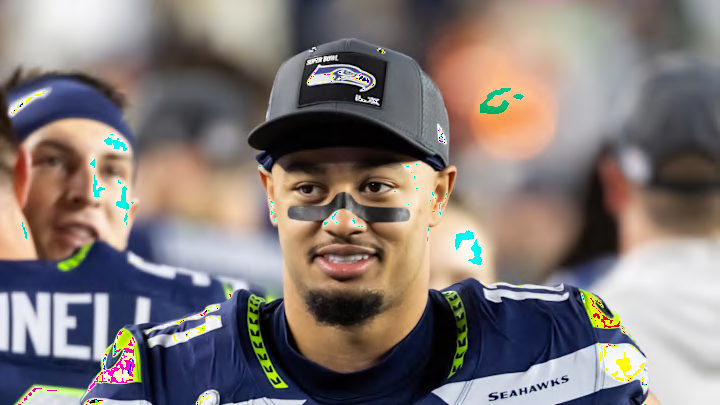
A story recently broke about the 2023 draft, when Joe Douglas, then general manager of the New York Jets, considered and rejected choosing Jaxon Smith-Njigba with the 15th pick in the first round. As every Seattle Seahawks fan knows, the Ohio State receiver was still on the board four picks later when John Schneider made JSN a Seahawk. It worked out pretty well for Seattle.
Instead of JSN, Douglas went with Iowa State defensive end Will McDonald IV. McDonald has been perfectly fine for the Jets. 18.5 sacks over two seasons is decent production. But of course, if you were redrafting, this would be no contest. JSN, who went 19th, would be no lower than seventh. There’s a good chance he’d be in the top five.
This story generated plenty of pejoratives being hurled at Douglas, now a personnel man with the Eagles. That’s not exactly earth-shattering. He struggled mightily trying to construct a competitive roster, and this latest story is simply one more anecdote of failure.
Let’s not pile on today. Let’s see what lessons we can take from the tale.
Seattle Seahawks' Jaxon Smith-Njigba was not judged on the right things by many scouts in 2023
Actually, Douglas’ selection of McDonald wasn’t all that bad considering several other moves made by rival GMs that year. Chris Ballard of the Colts reached in a big way for woefully raw quarterback Anthony Richardson with the fourth pick.
The Raiders' Dave Zeigler took Texas Tech’s Tyree Wilson at seven. Wilson has started seven games in three seasons with Las Vegas. And Washington’s Ron Rivera looked at two cornerbacks at 16 and somehow decided Emanuel Forbes was the better pro prospect than Christian Gonzalez.
Each of those picks was made with JSN still available. Zeigler and Rivera are now out of those jobs, while Ballard somehow continues to run the Colts.
What’s most interesting about the Jets’ JSN decision is the rationale that is now being floated. I should probably say at this point that we don’t really know how accurate this latest report is, nor do we have any real insight into the exact decision-making process. I have not heard Douglas comment as yet, and he probably never will. Therefore, we may never know the entire story.
But there were two well-established knocks on JSN coming out of Ohio State, and both appear to have played into the Jets’ decision. For one thing, Smith-Njigba missed most of his junior year with a bad hamstring. Some teams view that as a warning sign for a receiver. That’s reasonable, though perhaps a little overly cautious.
The other issue, which appears to have been more significant, was JSN’s mundane 40 time. In hindsight, he was not fully healthy through the pre-draft process, topping out his 40 time at 4.52. Simply put, there were teams, apparently including the Jets, that thought he was not fast enough. Instead of drafting JSN, Douglas signed free agent wideout Mecole Hardman, who ran a 4.33 40.
If you go back and read the pre-draft scouting reports on Smith-Njigba, you will find scouts cautioning about his lack of elite physical traits. They all loved his productivity. During his sophomore season, he was spectacularly productive against elite competition.
Everyone recognized his advanced skills. But some scouts just thought he wasn’t athletic enough to employ those skills in the NFL.
Here’s the problem. JSN had a small frame. Average height. Below-average weight. Small hands and short arms. Both his vertical jump and 40 time checked in on the lower side of average. When the scouts talked about the lack of an elite physical trait, that’s what they referred to. What they apparently ignored were the agility scores that were off the charts.
JSN posted a short shuttle and three-cone drill that rivalled some of the best ever. The shuttle tests an athlete’s ability to stop and start quickly. The 3-cone shows how well he can maintain speed while changing direction.
For a receiver, it’s not hard to make the case that those two drills are more important than a 40 time, and yet we still all go out of our minds when a prospect clocks a 4.3. Xavier Worthy’s record-setting 4.21 a few years back moved him from the late second or possibly third round into the back half of round one. Through two seasons, he has been a perfectly average receiver.
Ladd McConkey, another undersized receiver with very good short shuttle and 3-cone times, went six picks later. So far, McConkey has been significantly better than Worthy as a pro.
If we are to believe recent reports, Joe Douglas – and other NFL GMs – saw Jaxon Smith-Njigba’s elite production at a premier program, watched verifiable route-running and ball-catching skills, and had evidence of athletic agility that rivaled some of the best of all time, and still passed on a player they needed because his straight-line 40 time was considered too slow.
Apparently, a lot of NFL GM’s have learned nothing from Jerry Rice. Or Terrell Owens. Or Cooper Kupp. They all had slow 40 times. They have 16 first-team All-Pro selections to their credit. John Schneider is not one of those GMs. Of course, he'll miss some players. It's more art than science. But Schneider appears to know what matters and what doesn't a little bit better than most other GMs.
That's why he is the reigning GM of the year. And why JSN now has a first-team All-Pro selection of his own. And the Seahawks have the Lombardi Trophy. The Jets? Well, they're still the Jets.
 Add us as a preferred source on Google