

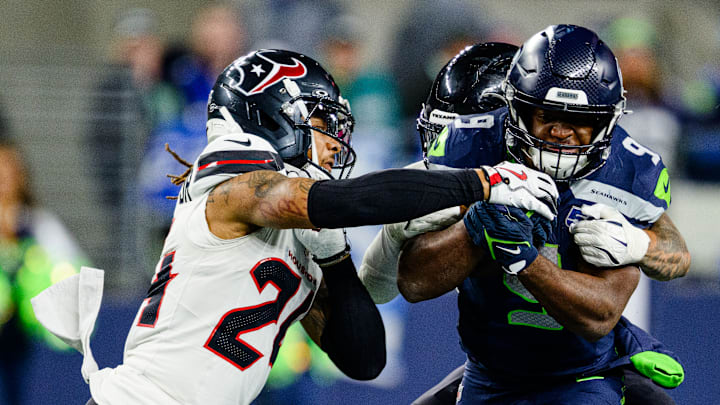
When Klint Kubiak was hired to be the Seattle Seahawks’ new offensive coordinator, he made one thing very clear. The Seahawks were going to run the ball. A lot.
Through the first ten weeks of 2025, he has made good on that promise. Seattle has moved from the fourth-lowest runs-per-game in 2024 to the second-highest in 2025. Only the Buffalo Bills have run more than the Seahawks this season.
Kubiak is running about 30 times per game, up from just over 22 attempts under Ryan Grubb last season. Part of that may be due to personnel. Grey Zabel and Jalen Sundell are now starting on the line (Sundell will miss some time with an injury sustained last week against Arizona). Anthony Bradford and Abraham Lucas are healthy, creating much steadier balance, at least in terms of run blocking.
Will the Seahawks’ running game carry them deep into the playoffs?
But the change seems to be largely attitudinal. Seattle made their commitment to the run very clear when it chose Georgia tight end Robbie Ouzts in the fifth round of the 2025 draft. Ouzts was rated as a seventh-round tight end prospect – or as a free agent – on many draft boards. But John Schneider didn’t draft him to play tight end. He was drafted to be a lead blocking fullback.
As games begin to matter in Seattle’s expected playoff push in December, one of the biggest questions Kubiak will face is whether he sticks to the plan and runs the ball.
On the surface, this would seem to be a no-brainer. Of course, Seattle is going to keep running the ball. The increased running has helped them to a 7-2 record and first place in the NFC West. But it isn’t quite that simple.
For one thing, Seattle really isn’t running the ball very efficiently. Their 3.8 yards-per-carry is actually fifth-lowest in the league. It is a full half-yard worse than they were last season. Despite running the ball eight additional times this year, they are only gaining 20 additional yards.
And they haven’t been consistent in terms of production. In Seattle’s most productive game of the season, they averaged 6.1 yards per carry. That is the only game in which they have been higher than 4.5. In two games, they have been under three yards per carry.
And perhaps strangest of all, they lost that 6.1 yards-per-carry game against Tampa Bay. More on that in a moment.
Seattle has proven it can win games even if they do not run the ball efficiently. And Kubiak deserves credit for sticking with the game plan even when Kenneth Walker and Zach Charbonnet are getting repeatedly stuffed.
After averaging 22.5 runs per game last year, the Hawks have run at least 20 times in every game of 2025. They have run more than 30 times in four games and hit their season high – 44 rushing attempts last week against Arizona.
Two of Seattle’s wins this year came in games when they averaged under 2.5 yards per carry. That may seem like a good thing. But it is covering up a potential problem.
Simply put, Seattle’s passing offense is much more effective than its running offense right now. When he gets into a close game against a good team come playoff time, there is going to be a lot of pressure on Kubiak to turn away from the run and start letting Sam Darnold and Jaxon Smith-Njigba try to win the game in the air.
Which brings us back to that game in which Seattle had its most efficient running day of the season. The game that it lost to Tampa Bay.
It was a shootout, pure and simple. Seattle ran the ball 20 times – it’s lowest total of the year. Darnold threw the ball 34 times – his highest total of the year. Despite falling behind 13-0 early, the Seahawks quickly came back, and for most of the game, no team was up by more than a touchdown.
Therefore, the game script doesn't really explain the play calling. When Kubiak did dial up running plays, they tended to work.
But the passing plays were working too. As a result of the imbalanced play selection, Tampa ended with a significant time-of-possession advantage, and of course, a win.
Kubiak’s challenge in the second half of the season is twofold. The first part is simple. He has to continue the commitment he has shown to running the ball, even when the running plays are sputtering. Fortunately, Seattle’s defense is so good that it is unlikely they will fall into a deep hole early.
But he also has to increase that efficiency. Walker and Charbonnet have been on a bit of a roller coaster, flip-flopping between productive games and difficult games. It would be nice to see more even performance from week to week.
A couple of clues emerged in last week’s win over Arizona that might signal how the second half of the season will play out. For one thing, Ouzts is back from injury and equaled his season high for snaps, which he had previously achieved in Week 2 against Pittsburgh.
Combined with the powerful blocking tight end Nick Kallerup, who appears to be taking over for an injured Eric Saubert, this should give Seattle a more potent line in front of the runners.
The play calling and personnel usage against the Cardinals was no doubt influenced by a game script that saw the Hawks build a huge early lead and then naturally run the ball a lot. One interesting note, though, seems unrelated to the game script.
The newly acquired receiver Rashid Shaheed ran the ball twice and was only targeted in the passing game once. It seems obvious that those targets will rise as he develops rapport with Darnold, but it may be that John Schneider brought Saheed to town to help diversify an inconsistent running game as much as to juice up the passing attack.
Time will tell. But given Seattle’s first-rate defense and high-powered passing game, if Kubiak can figure out the running game, this team could be very hard to beat.
 Add us as a preferred source on Google