

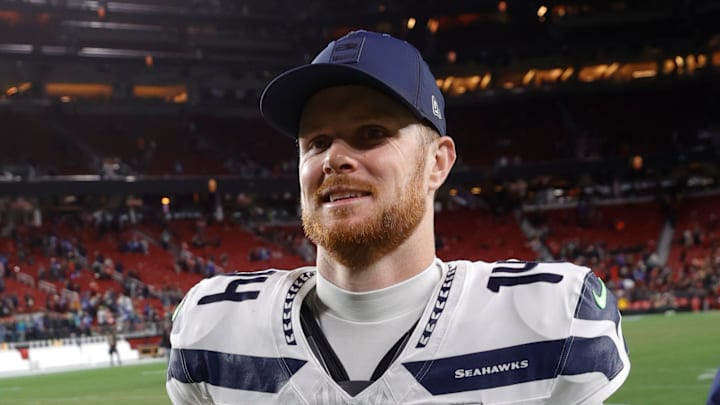
The most common refrain I have heard regarding the Seattle Seahawks over the past two months is this: if Sam Darnold can protect the football, the Seahawks can win the Super Bowl. Since I am about to take issue with that, I feel like I need to make one point clear at the outset.
I am not advocating that Sam Darnold should throw a bunch of interceptions. I am not enough of a contrarian to suggest that throwing interceptions is somehow a good thing. Indeed, if Darnold throws four of them, as he did against the Rams in Week 11, Seattle will probably lose.
With that disclaimer out of the way, let’s get to the main point. Interceptions, though certainly bad, are not as bad as most commentators would have you believe. More importantly, especially for Darnold and the Seahawks, if the fear of throwing a pick prevents Seattle’s offense from remaining aggressive, that is actually worse than throwing an interception or two.
Sam Darnold must remain aggressive for the Seattle Seahawks to win a championship
I am continually surprised by fans and experts alike who simply refuse to acknowledge data. Here’s one data point from the Wild Card Round of this year’s playoffs.
(Note: I am writing this on Monday afternoon, before the Texans-Steelers game on Monday night, but I do have five games’ worth of data to consider.)
In the five Wild Card Round games played on Saturday and Sunday, four of the ten participants threw zero interceptions. Three of them threw a single pick while the other three had two.
Now, based on everything we have had hammered into our heads throughout all of football history, the teams with zero interceptions should have done better than the teams with two. That is not what happened. Not even close.
The four teams without an interception went 1-3 over the weekend. The three teams that threw multiple picks were 2-1, as were the teams that tossed a single pick. Overall, the five teams that won threw six interceptions while the five that lost threw just three.
How is this possible?
It is possible because of the very fundamental fact that the negative impact of an interception is not equal to the positive impact of a touchdown. An interception may or may not result in points. You might lose points, or your opponent might gain them, but neither is a certainty.
On the other hand, if you score a touchdown, you absolutely, positively do score points.
Seattle’s passing attack must remain aggressive. Darnold has to take shots downfield. He has to try some difficult, tight window throws. If he doesn’t, then Seattle’s offense is less likely to score, and that is far more dangerous than an interception or even two.
Two conditions need to be met in order for what I am arguing to be accurate.
First, the quarterback in question has to be capable of generating touchdowns if he is allowed to be aggressive. Darnold is such a quarterback. He finished ninth in the league in touchdown percentage this season, meaning that when he does throw it, good things tend to happen.
Second, the team in question needs a good defense, which will minimize the negative impact of an interception. Seattle clearly has that.
The only two teams in the playoffs with a quarterback who was below the league average in touchdown percentage this year are Houston and Denver. Along with Seattle, they probably have the best defenses in the NFL.
That means Seattle has the best of both worlds – a quarterback who can generate touchdowns and a defense that can prevent them. Of course, they lose if Darnold has a disastrous game and turns the ball over half a dozen times. But the more likely reason they will lose is that Darnold becomes so afraid of a couple of picks that he stops being aggressive and stops throwing touchdowns.
That is almost what happened in Week 15, when Seattle very nearly lost a game they had no business losing to Indianapolis. Going up against a below-average pass defense, Darnold was tentative. His passer rating for the game was almost 15 points lower than his season average. He did not throw an interception, but he also did not throw a touchdown pass, and the Seahawks eked out an 18-16 win.
It should not have been that close. They were playing a struggling team with a 44-year-old QB who had been out of football for five years, and they played not to lose.
You may know that the career leader in interceptions in NFL history is Brett Favre. Others in the top ten include Peyton Manning, Johnny Unitas, Dan Marino, and Y.A. Tittle. There’s a lot of winning in those arms, including five NFL championships and even more runners-ups. Seattle can win if Sam Darnold throws a few interceptions. They cannot win if he fails to generate touchdowns.
 Add us as a preferred source on Google