

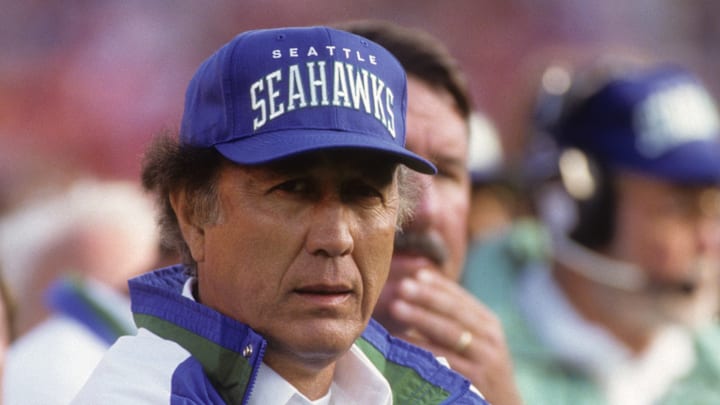
The 90s were not kind to the Seattle Seahawks franchise. We can ignore the 1970s, as they first took the field in 1976. But even then, the 90s stand out as the worst decade in franchise history. Two-time Super Bowl champion Tom Flores is the biggest reason for that failure.
The 90s were not kind to the Seahawks franchise. The 70s weren't exactly great, not with that 2-12 inaugural record, but Seattle played at a very respectable .480 clip after that. Their compadres in the 1976 expansion, Tampa Bay, only managed a .266 winning percentage in their first decade. Even tossing out their miserable winless first season, the Buccaneers were only a .354 ball club for the 70s.
As for Seattle, the 90s stand out like your little toe when you slam it into a chair leg. It's a major pain. If the 2010s are the Sgt. Hulka of the Seahawks - you know, the big toe - then the 1990s are the Capt. Stillman. Stripes fans, help out the other people. And if anyone stood out in that benighted decade as the real-life Stillman, it would be two-time Super Bowl Champ Tom Flores.
Tom Flores did double duty as a terrible coach and GM for the Seahawks
Before we dive further into the atrocities wrought by Stillman - sorry, I mean, Flores - let's take a closer look at how each decade played out for our beloved Seahawks. Just a couple of notes: those 100.5 wins in the 2010s account for that awful 6-6 tie with the stinking Cardinals in 2016, as does the half loss. The playoff column shows Seattle's playoff record for the decade, with the number of seasons they made the playoffs in parentheses.
Decade | Wins | Losses | Percentage | Playoffs, App |
|---|---|---|---|---|
1970s | 25 | 35 | .417 | 0-0 (0) |
1980s | 78 | 74 | .513 | 3-4 (4) |
1990s | 70 | 90 | .438 | 0-1 (1) |
2000s | 82 | 78 | .513 | 4-5 (5) |
2010s | 100.5 | 59.5 | .628 | 10-7 (8) |
2020s | 47 | 37 | .560 | 0-2 (2) |
Total | 402.5 | 373.5 | .519 | 17-19 (20) |
The Seahawks had five winning seasons in the '80s and made the conference championship game once. Head Coach Chuck Knox was responsible for much of that success, as was Seattle's general manager, Mike McCormack. McCormack hit the lottery by drafting Curt Warner, but other than Brian Blades, Tony Woods, and Dave Wyman, he didn't give Knox much to work with over six seasons.
New team owner Ken Behring (hold your applause, 12s) realized it was time for a change. He saw that Tom Flores was out of work after two fourth-place finishes in the division, and hired him as Seattle's new president and general manager. Remember, the Seahawks finished ahead of the Raiders both years.
And more importantly, Al Davis ran the Raiders. He was the owner, the general manager, basically the king of the Silver and Black.
So why Behring thought that Flores had the experience needed to take Seattle to the next level is beyond me. It's not like there wasn't talent out there. The Bills hired Bill Polian in 1986. After working for Marv Levy with the Chiefs, he assembled a Grey Cup championship squad in the CFL and was the director of player personnel for Buffalo in 1984.
He later made the Bills and Colts into perennial playoff contenders. Even better, Behring could have stolen John McVay from the 49ers. But considering he was the dope who wanted to move the team to Anaheim, what could we expect?
So, enter Tom Flores via the buddy system. Why hire someone qualified when one of your pals is out of work, right? Flores spent the 1988 season in the Raiders front office, probably making coffee for Davis. That's not a knock on Flores' abilities, but the amount of control Davis exerted. Who knows, maybe he convinced Behring that he's the guy who drafted Tim Brown.
Flores wasn't exactly Executive of the Year material
Regardless, Flores became Seattle's GM in 1989. Of their draft 12 picks, they got Andy Heck, a fine offensive tackle, and running back Derrick Fenner, who had a great year for the Seahawks in 1990. After that, he was a decent backup. The 1990 draft was a huge hit, as Seattle landed Cortez Kennedy and Chris Warren, along with Terry Wooden and Robert Blackmon.
1991 had its upside, as Flores drafted kicker John Kasay and defensive end Michael Sinclair in the fourth and sixth rounds. I'm not sure that makes up for taking Dan McGwire with the 16th overall pick, though. It could have been worse; it could have been Todd Marinovich, who, of course, was drafted by the Raiders.
Not like Brett Favre was just sitting there until the second round or anything. Kasay was great, but taking a kicker in the fourth round when no other kicker was taken until the sixth is a bit odd.
In 1992, Seattle took left tackle Ray Roberts with the 10th overall pick, but whiffed on the next 11 selections. In 1993, Seattle led off with another infamous first-round selection, QB Rick Mirer. They added some serviceable players, most notably DE Michael McCrary. Flores fared better in 1994 with defensive tackle Sam Adams and center Kevin Mawae, but neither became a Pro Bowler until they left Seattle.
Overall, I have to give Flores a little credit as the Seahawks' GM. He drafted about a dozen solid to great players in his six years running the draft. But seriously, when you only average two really good picks a year and you had 54 shots at getting the right guy, you're not exactly Executive of the Year material.
Especially not when you drafted both McGwire and Mirer. But if you thought he was bad as a GM, wait till you see what he did as a coach.
The two-time Super Bowl champ lost his mojo
I don't think I need to go into excessive detail regarding the dismal, abhorrent, and not-very-good 1992 Seahawks season that saw them go 2-14. I've already diced that up pretty well, I think. I'll just sum up by saying that the defense was good and the offense was historically awful. Yes, Seattle lost both Mirer and McGwire to injury, but that could have been a blessing in disguise.
Or it would have been if Flores hadn't decided Stan Gelbaugh was an NFL quarterback. Sorry, that part belongs with his failures as a GM.
As for his coaching, Flores was simply awful that season. He came in with a reputation as a keen offensive mind. He was a pretty decent quarterback in the days of the AFL; a lot better than Mirer, let alone McGwire or Gelbaugh. Yet Seattle managed to score just 140 points. Yes, the league was playing 16 games then, and no, it wasn't a strike-shortened season.
Happily, the Seahawks were better in 1993. Normally, a four-game improvement is reason for celebration. But when you start in the sub-cellar, you're only likely to make it to the basement. And that's where Seattle finished, still fifth place in the division. They doubled their offensive output, from 140 points to 280. That would normally call for parades down Fourth Avenue.
Despite ranking 19th in points scored and 18th in points allowed, the team still lost. An efficient team would have been 8-8, while a team that played well in pressure situations could have turned that into a 10-6 record.
Yet Flores managed to snatch defeat from you-know-where repeatedly. Seattle was 2-4 in games decided by six points or less. Those are the same kind of results that eventually ushered Pete Carroll out of Seattle.
In 1994, the Seahawks' stats stayed about the same, as did their record. Despite Chris Warren's 1,545 yards on the ground and Brian Blades adding 1,086 through the air, Seattle simply didn't have enough firepower or the ability to properly apply it. They were better in the close games, going 3-3, but they were on the wrong side of too many blowouts.
Flores was 3-4 in games decided by at least two touchdowns, and lost all three when the margin was between 7 and 12 points.
Add it all up, and the guy who won two Super Bowls managed to go 14-34 for Seattle. A lot of conjecture about his long wait for the Hall of Fame was due to his failure with the Seahawks, and that Al Davis had more to do with the success of the Raiders than Flores.
I believe that he simply took too much on in Seattle. He had no business being a GM. Yes, he drafted Cortez Kennedy, but taking Dan McGwire negates that pretty handily.
As a person, there's no disparaging Tom Flores. He wasn't the right guy for the Seahawks; that's not up for debate. But when you consider all that he accomplished, no one can say that Flores wasn't a Hall of Famer. With the Seahawks, he was in the wrong place at the wrong time. But everywhere else, Tom Flores was a winner.
More Seahawks news and analysis:
 Add us as a preferred source on Google