

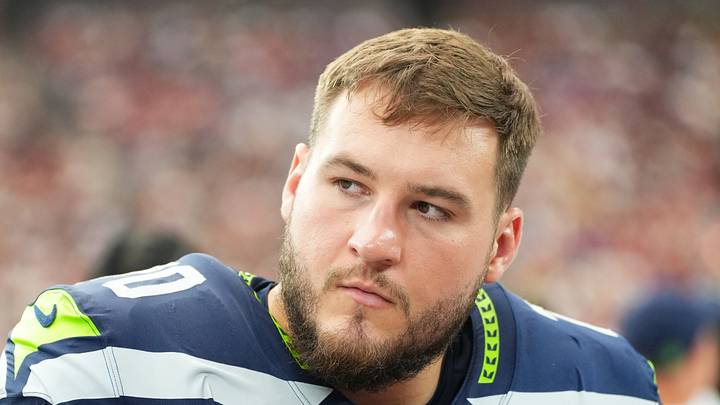
The Seattle Seahawks couldn't protect their quarterback Thursday night. As hurried as he was, Sam Darnold rarely had time for deep throws. This may have doomed Seattle's chances to win in Week 6, but it isn't the real issue for this team.
The calling card of the Seahawks offense has been explosive plays. Last year, Seattle ranked 11th in the league in receptions of 20 yards or more. After week 5 of this season, the Seahawks were even better. Darnold had thrown 12 passes for 20 or more yards. Considering he missed two games, that's not bad at all.
It isn't as if Drew Lock took those two games off, either. He completed five himself. With 17 explosive connections in all, this put the Seahawks tied for fourth in the league. That advantage disappeared on Thursday night against the Broncos, as Darnold only completed two explosive passes. So how much did it cost them?
Seattle Seahawks have to block better to bring the deep ball back
Let's take a deeper look at how the team fared through those first five games. You know what that means, gang. Yes...it's time to get mathy.
The Seahawks connected on three 20+ passes in Week 1, the biggest a 45-yard completion to Jaxon Smith-Njigba. In Week 2, Seattle connected just twice, but it was also against the overmatched Cardinals. Week 3 saw Sam Darnold complete five deep balls versus the Commanders. He threw another four in Week 4 and completed three more in the Week 5 loss to the Niners.
On the surface, that all looks great, right? But remember that mathy thing? Yeah, things weren't that simple. Let's look at the average yards Darnold's passes travel through the air. That's the first step in seeing a clearer picture of what's really happening with this offense. I skipped Darnold's sole completion in Week 1, so for the first two games, those are Drew Lock's numbers.
Opponent | Completed air yards | Yards after catch |
|---|---|---|
Patriots | 5.3 | 6.4 |
Cardinals | 6.7 | 5.7 |
Commanders | 6.8 | 5.5 |
Chargers | 5.8 | 7.1 |
49ers | 4.7 | 6.1 |
Broncos | 4.1 | 2.6 |
Now, you don't have to have an advanced degree in higher mathematics to see those numbers keep dropping week after week. If you're a bit new to the game, completed air yards are how far the ball traveled past the line of scrimmage before the receiver caught it. Yards after catch -- well, I don't think I can help you if you can't figure that one out.
The point is that, on average, the Seahawks throw fewer deep balls every week. Even worse, when they (okay, it's Darnold) complete the pass, their receivers aren't getting the ball where they can escape tacklers. That tends to happen when you're pressured 27 times, as he was by the Broncos. I'll freely admit that Darnold could handle this pressure better. Maybe it's his coaching. Or maybe...
Let's look past the Broncos game. If that had been the only one, the Seahawks wouldn't be 3-3 now. But Darnold has been pressured far more this season than last. He was pressured on 36.1 percent of his pass attempts in 2025, but this year, that pressure rate has climbed to 42.7 percent. That may seem like a small difference, but it isn't.
It's about three pass attempts per game, and that does seem small. But turn two of those into completions, and we have a different record. Why two? Darnold completed 68 percent of his passes last year, but just 60 percent in 2026. His interception rate jumped from 2.9 percent to 4.7 percent. That's one miss into a catch, and one pick into another. The Denver loss wouldn't have happened.
Perhaps worst of all, Darnold's time to throw has skyrocketed this season. In 2025, his average time to throw was 2.86 seconds. This year, it's climbed to 3.25 seconds. Not even four-tenths of a second shouldn't be a big deal, right? Plus, isn't he getting more time to throw? Not so fast. It won't take more than four-tenths of a second to break this down, so bear with me.
He isn't getting more time; he's creating that time by running for his life. It isn't all on Sam Darnold. And at the end of those four-tenths of a second, Darnold is forcing throws more than ever. We've all heard the adage that football is a game of inches. On any given play, that holds. But in the big picture, it's a game of yards, and especially of seconds. And Sam Darnold isn't getting those.
 Add us as a preferred source on Google