

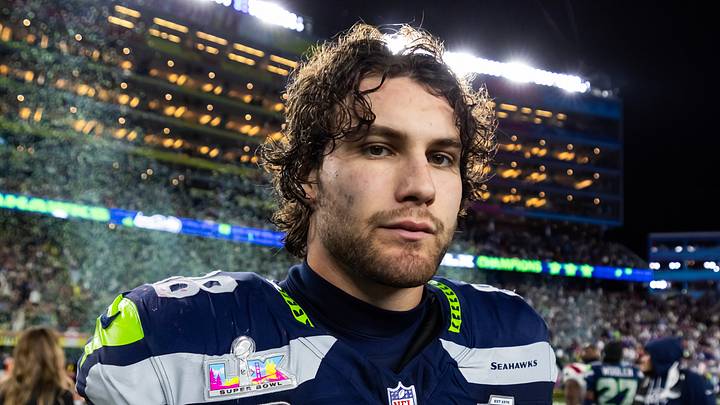
The Seattle Seahawks are 3-2 and getting ready to face a quality opponent on the road with a short week of prep. There is a very good chance that before the week is through, the defending Super Champions could be at .500 for the first time since Week 2 of the 2025 season.
Since their two losses have come by a total of five points, it is safe to assume that Mike Macdonald’s club is not too far away from playing the type of quality football fans saw in the second half of 2025. And there is still ample time this season to correct problems. Even if the Hawks do lose in Denver this Thursday, there is no cause for panic.
But there is plenty of cause for concern. We’ve gone over a lot of the problems that have beset the club during its sputtering start. The lack of a running game, the abundance of turnovers, and the defense’s inability to come to the rescue quite as easily as it did last year. Let's focus on individual players.
4 players who need to step up for the Seattle Seahawks in Week 6
At the end of the day, every player and every coach will tell you that this is what it always comes down to. Regardless of scheme or play call or fluky bounce – regardless of weather or injury or questionable penalty – most football games are won or lost by players winning their individual matchups against an opponent.
I am not claiming these players are performing badly. In some cases, one or two of them may indeed be underperforming. But it isn’t as if they are terrible players who need to be benched. They simply need to have a larger, more consistent presence.
Only one of them plays defense. That does not mean the other defenders couldn’t be better as well, but this particular defender is the most obvious problem right now.
Josh Jobe, CB
Here’s the thing about Jobe. He’s 5’11”, 190 pounds, and unlike the similarly-sized Devon Witherspoon, not an elite athlete. Jobe is a grinder who has worked his way up from being an undrafted free agent to being a starter on a Super Bowl champ. As he showed in Week 1 against the Patriots, he is fully capable of making big plays.
But he has been struggling of late. Those struggles were very apparent against Mike Evans on Sunday. Evans is a future Hall of Famer. He towers over Jobe, and neither the corner nor the defensive coaches could seem to find an answer. Seattle’s stifling zone does a nice job of keeping speedy, explosive receivers in check. But it does struggle against bigger wideouts.
The whole league looks bad against Puka Nacua, but he has field days against the Seahawks. In three games against Seattle last year, the physical Rams star averaged one-and-a-half catches and almost 60 yards more than he did against the rest of the league. Seattle may have dodged a bullet in Week 1 against New England when AJ Brown left the game.
The entire defense has to figure out how to contain bigger receivers, but it will fall on Jobe most of all. This is even more pronounced since the Hawks essentially chose him over the bigger Riq Woolen in free agency this season. Woolen is playing pretty well in Philadelphia. Jobe needs to up his game, and his coaches need to figure out ways to help him.
Sam Darnold, QB
The other three players are on offense, and I should note right up front that the jury remains out on Brian Fleury, the new offensive coordinator. No one is suggesting he won’t develop into a fine play-caller, but he is not there yet.
As for Darnold, it’s the same old, same old. Too many turnovers. I would never suggest turnovers are a good thing, but I watched Brett Favre win too many games despite throwing the most interceptions in NFL history, to say things are that simple. Darnold has to take chances, and chances will result in turnovers.
Darnold’s problem is not the interceptions, at least not in isolation. His problem is the lack of touchdowns. I say that, knowing that the first loss this year, against Washington in Week 3, did not fit this pattern. Darnold threw plenty of touchdowns, but the team still lost. Again, I am not advocating more interceptions.
But consider this. Last year, Sam Darnold threw at least one interception in nine games. Seattle won seven of them. They won, usually, because he also produced touchdowns. The San Francisco game was a perfect example.
If JSN doesn’t drop a pass on the final drive, and if Darnold is able to get the team into the end zone, they win. So you can blame the picks if you like. I prefer to look at the other side. The passing game needs to produce more touchdowns.
AJ Barner, TE
Speaking of more touchdowns in the passing game, AJ Barner has yet to find the end zone in 2026. At least not as a pass catcher. It’s all well and good that he can power in on the goal line, as he did in Week 4, but Barner needs to be a bigger presence in the passing game. He caught six touchdowns last season and another in the Super Bowl.
His overall presence in the passing game is off from last year’s pace. He is seeing fewer targets, fewer catches, and fewer yards, in addition to the touchdown drop-off. The NFL maintains a stat called “success rate,” which measures a receiver's production based on down and distance. Barner had identical 63.2 success rates in his first two seasons. That is a very solid benchmark.
In the first month of 2026, that number has dropped to 50.0. Again, the Seahawks have a new offensive coordinator, and it may take a while for things to sort themselves out. But this could be a big problem as the season progresses.
Seattle still does not have a second reliable receiving option after JSN. Rashid Shaheed has yet to prove he can be that type of wideout. Cooper Kupp is not what he once was. The younger players – Tory Horton, Elijah Arroyo – are not having an impact. And the running backs have not shown to be nearly as effective as pass catchers as Kenneth Walker and Zach Charbonnet were.
I’m picking on Barner because he was the best second option last year, but this is really a team-wide issue. Perhaps it is Montorie Foster time.
The right guard
This seems pretty simple. Christian Haynes and Beau Stephens have developed a 60-40 timeshare at right guard, with Anthony Bradford out. And I have no idea why. Haynes simply seems better. The offense seems to move better when he is on the field. Why is Stephens still getting 25-30 snaps per game?
We have all been told forever that cohesiveness is the single biggest factor in offensive line play. The best lines are the ones that stay intact and move as a unit. It would seem, to an outsider, that Seattle’s line – which has struggled mightily to open running lanes and protect the quarterback – would benefit from sticking one player in at right guard and leaving him there.
This, then, does not fall on the player unless somehow Haynes is doing something causing his coaches to question his every-down ability. This is on Brian Fleury and John Benton. Let Christian Haynes play an entire game.
 Add us as a preferred source on Google