

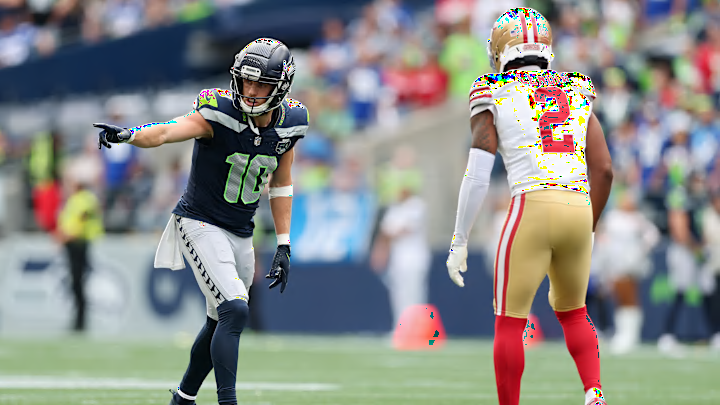
Even if you were one of the Seattle Seahawks fans who recognized that it might be time for DK Metcalf to move on. Even if you realized that Tyler Lockett’s time as an elite deep threat was in the past, and even if you placed great faith in Klint Kubiak and the Hawks’ expressed commitment to running the ball, you still knew there was a problem brewing with the Seahawks' offense.
Numbers do not lie.
2024 was considered a down year for Metcalf and Lockett. Still, together they combined to catch 115 balls for more than 1,500 yards. They scored seven touchdowns and converted 71 first downs. Their combined catch rate was 63% and their combined success rate – a figure which judges how many of their targets result in “successful” plays, based on down and distance – stood at 52%.
The players signed to replace them – Cooper Kupp and Marquez Valdes-Scantling – trailed by a significant margin in almost every category. Even adjusting for the higher number of games played by Metcalf and Lockett, Seattle’s 2024 receivers produced at a much higher level than their would-be replacements in every category save for touchdowns.
Given current personnel, can the Seattle Seahawks create an effective passing attack?
So the obvious question entering this season was who would replace all those yards and first downs?
It became clear that it would not be Valdes-Scantling. He was released before the season began. There was a lot of hope invested in draft picks Elijah Arroyo and Tory Horton. That hope remains, though they were both largely invisible in Week 1. That’s not unusual for rookies.
Seattle’s other receivers – Jake Bobo, Cody White, and Dareke Young - were all on the team last year and produced almost nothing. It didn’t seem like they would suddenly take a major leap forward.
That left the venerable veteran Cooper Kupp to fill in the gaps until the rookies could step up. Seattle was well aware of how good Kupp could be, having faced him many times when he played for the Los Angeles Rams. In 2021 alone, Kupp caught 16 balls for 228 yards and two touchdowns in his two games against Seattle.
Were you to extrapolate the 12 games Cooper Kupp has played against Seattle over a 17-game season, it works out to 99 catches, 1,154 yards, and seven touchdowns. I think we’d all be happy with that coming from whoever was playing alongside WR1 Jaxon Smith-Njigba.
Of course, the problem is that it is not the Cooper Kupp Seattle is getting. He is now 32 years old and coming off several injury-plagued seasons. That is never good news for a wide receiver.
Still, there was hope. Kupp was never a speed merchant. He relied on savvy route-running, body control, and excellent hands. If he could produce at about three-quarters of his normal level, that would still be a shot in the arm for the Seahawks offense.
In Week 1 against the 49ers, Kupp was not anywhere near that three-quarters mark. He may not have been at the one-quarter mark. It’s kind of subjective so it’s hard to quantify. Suffice to say, Cooper Kupp was not very good.
Pro Football Focus (subscription required) graded him as the 98th best receiver in Week 1. That’s out of 99 total receivers. Yep – if not for Denver’s Trent Sherfield, Kupp would have been rated as the worst receiver in the entire league in Week 1.
It wasn’t just his third-down drop late in the third quarter when the Seahawks were nursing a three-point lead. That was the most egregious play, but the fact is, Kupp was invisible all game. He was targeted three times and caught two passes for short gains. He actually was more useful as a blocker than as a receiver for most of the game.
Kupp simply couldn’t get open. He looked slow. He rarely found holes in the coverage the way he has done for so many years. That eventually led QB Sam Darnold to stop looking in his direction. That’s unfortunate because had he been looking at Kupp on Seattle’s final offensive play, the Seahawks probably would have won the game.
On second and five from the 49ers nine yard-line and with 42 ticks remaining on the clock, Darnold dropped back, looked straight left toward Jaxon Smith-Njigba and lost the ball before he could get the pass off.
Had he been looking in the middle of the field, Cooper Kupp was wide open. He ran a short turn in and found that soft spot. He either would have scored or been stopped right at the goal line. Either way, Seattle’s odds to win would have skyrocketed.
But by this point, Darnold was looking for JSN on every play because he was the only Seahawk receiver who had proven capable of getting separation throughout the game.
So the question has to be asked. Does Sam Darnold have confidence throwing the ball to Cooper Kupp? Back to that drop in the third quarter. Kupp is running a short slant and establishes inside leverage. Darnold puts the ball on him, and he drops it.
What may not have been noticed initially is that when Kupp makes his break inside, he stumbles. It wasn’t big. He didn’t go to the ground. He still ran his route. But it’s hard to think that the stumble did not affect his timing and lead to the drop. Kupp rarely drops those passes.
This is of particular concern because Cooper Kupp did not get separation for most of the game. When he really needed it, it looked as if his body couldn’t deliver. That happens to athletes when they lose something off their fastball. They push too hard and make mistakes.
It could be a total fluke. It could be an issue of a new system and a new quarterback, and a veteran receiver who did not play in the preseason. It could simply be a matter of rust that will work itself out in time.
But it bears watching. Because at some point, all receivers lose their ability to perform. If that is happening to Cooper Kupp right now, Seattle’s offense is in big trouble.
 Add us as a preferred source on Google