

Heading into their titanic Week 15 showdown with the Los Angeles Rams, the Seattle Seahawks’ defense was on a dominant run. They had held five straight opponents to under 300 total yards. Their average over that stretch was 240 yards allowed per game, 90 yards lower than the league median.
On the season, Mike Macdonald’s club had only let opposing offenses top 300 yards in three of 14 games.
Matthew Stafford and the Los Angeles Rams ran up 581 yards on the Seahawks. Of course, they did have one extra overtime drive to reach that total. In regulation, the Rams only managed 501 total yards.
What happened to the Seahawks’ defense? The same defense that limited this Rams' club to just 249 yards five weeks ago. The Rams were playing without standout receiver Davante Adams and lost one of the best guards in the NFL, Kevin Dotson, early in the game, yet they still managed to move the ball at will.
Seahawks defense goes on roller coaster ride against the Rams
The only team that had gone for more than 400 yards against Seattle before Thursday was the Tampa Bay Buccaneers in a Week 5 shootout. Almost all of Tampa’s yardage came courtesy of Baker Mayfield’s arm. The Bucs’ QB threw for 370 yards in that game, but Tampa only managed 56 yards on the ground. They averaged 2.3 yards per carry.
The first thing to recognize about Seattle’s performance against the Rams in Week 15 is that LA was dominant both through the air and on the ground. Los Angeles ran for 124 yards, more than twice what Tampa managed back in October.
In the first half, the Rams’ offensive line controlled the game. Seattle has one of the best front sevens in the NFL, but they were no match for Sean McVay’s troops for much of the game. The story was spelled out clearly on first downs.
In the first half, the Rams ran 17 first-down plays. That number alone would cause concern. What they did on those plays, especially against a team whose identity is built on the defensive side of the ball, might lead to actual panic.
The Rams threw the ball on just six of those first-down plays. They averaged almost 20 yards per first-down pass attempt. Of course, that number is inflated by Puka Nacua’s huge 54-yard reception, but Stafford also completed passes of 27 and 19 yards on first downs in the first half.
More problematic, LA ran the ball a dozen times on first down and averaged more than five yards per play. A team that consistently gives up more than five yards per run on first down cannot stop an opponent.
That opponent will either continue to pound the ball on the ground or slowly move into scoring range. Or else they will wait until the defense is forced to cheat its linebackers and safeties forward, and then hit them over the top for quick scores.
In the first half against Seattle, the Rams did both. The Seahawks’ defense could not stop Kyren Williams and Blake Corum from pounding the ball right up the gut. When Macdonald dialed up blitzes, it left holes in the secondary.
Often, those holes appeared to be the result of mental errors. Puka Nacua and Konata Mumfield made some excellent catches against tight coverage, and there is not much that a defense can do in those situations. But there were several times when those receivers were running free through massive gaps in the zones.
The entire defense simply appeared discombobulated.
And then, when all hope seemed lost, Seattle’s best unit came alive.
After Darnold’s second interception killed a fourth quarter drive and left the Hawks down by 16 with less than ten minutes to go, Seattle's D showed just how dominant it could be.
The Rams had already gained over 400 yards by this point and probably needed just one more sustained drive to put the game on ice. The Seahawks held them to 14 combined yards on three consecutive series. Nine plays. An average of 1.6 yards per play.
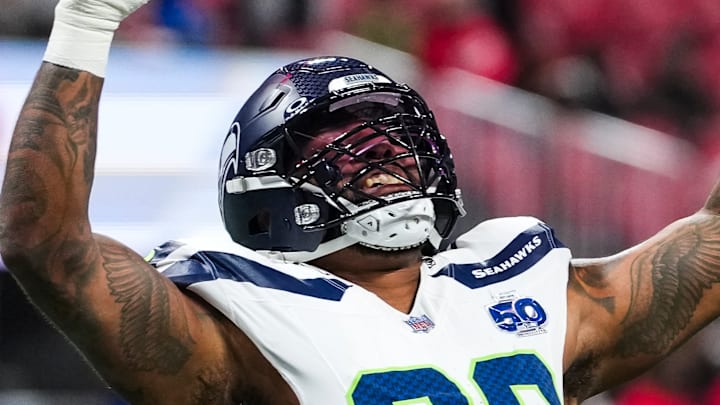
DeMarcus Lawrence was a beast during that stretch. Leonard Williams and Byron Murphy, who had been getting pushed around for much of the game, stuffed those running lanes. The pass rush picked up, and the secondary made sure to blanket Nacua.
The first defensive stand set up Rashid Shaheed’s momentum-swinging punt return. The next set up the tying touchdown. After the Rams’ touchdown early in the final quarter, Seattle kept them off the scoreboard throughout the remainder of regulation and allowed the special teams and offense to mount a comeback.
The defense faltered again in overtime, with more blown coverages. But on the plus side, they did at least shut down LA’s running game, which had caused such trouble in the first half.
So the question remains, which is the real Seattle defense? The dominant, aggressive unit that we have seen much of the year, or the confused group that gives up big runs on first down, and has breakdowns in coverage. Both were on display against Los Angeles.
 Add us as a preferred source on Google