

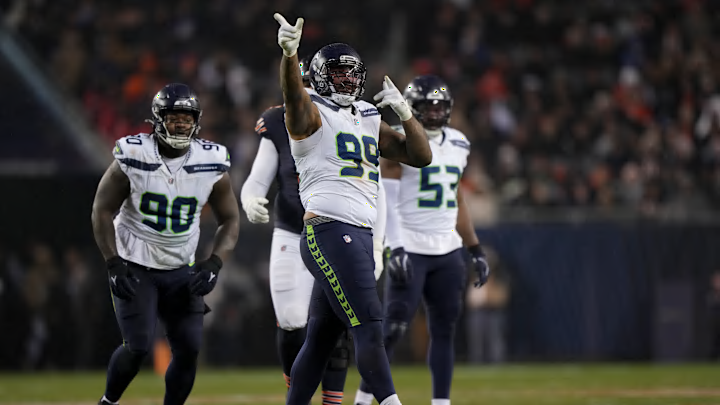
It can be a little too easy to look at the success Seattle Seahawks head coach Mike MacDonald had coaching the Baltimore Ravens’ defense and assume he is trying to recreate that system in Seattle. Good coaches tailor systems to players rather than the other way around.
Still, it’s not a stretch to say that when he arrived last season, he found a defensive lineman in Leonard Williams who was an upgrade over the Ravens’ very good Nnamdi Madubuike, and in Devon Witherspoon, a defensive back with the versatility of Kyle Hamilton.
The draft picks John Schneider has made since bringing Macdonald in would seem to confirm there is at least a partial move toward replicating that Baltimore system. Big active linemen like Byron Murphy II and Rylie Mills. A safety who can cover the entire field in Nick Emmanwori.
Why did the Seattle Seahawks sign Justin Rogers?
They are all top-tier athletes who could play in any system, but are especially suited to the attacking style of defense Macdonald employed with the Ravens.
Of course, you can only push a replication project so far. At linebacker, Schneider brought in two linebackers last offseason who, on paper, approximated the Ravens’ Roquan Smith and Patrick Queen. But those are rare athletes – especially Smith.
Jerome Baker and Tyrel Dodson could not match them, and Macdonald wisely corrected course, opting for backers who might not cover quite as much field but were sure to make tackles.
So I don’t think Mike Macdonald is so intent on rebuilding a Ravens-style defense that he will avoid different types of players and schemes. But I do think there is one position where he desperately wants to find some of the magic he had in Baltimore. He wants to find a true mammoth nose tackle. Actually, he probably wants two of them.
Just before the veterans reported to training camp, John Schneider made two seemingly minor roster moves. One was the result of injury. Cornerback Zy Alexander was waived with an injury designation and was replaced by another corner, Kam Alexander.
The other move involved signing undrafted free agent Justin Rogers, formerly of Auburn.
Rogers is listed at 6’3”, 338 pounds. He is a classic nose tackle, and he joins a roster that already has Brandon Pili, Quinton Bohanna, and Johnathan Hankins. Those four men carry three-quarters of a ton between them. They all project as classic run-stuffing nose tackles.
Hankins played this role at times last season, but often, Jarran Reed lined up in the one or zero gap near the center. Occasionally, Byron Murphy did it. Reed and Murphy are talented enough athletes to do this. So are Leonard Williams and Rylie Mills. But you don’t want them there, except perhaps in the odd package or two.
Those rangy, quick, athletic linemen will set up all over the place in Macdonald’s system, but you don’t want them right in the middle of the field, where they will almost certainly face double teams. You want them free to use their speed, to stunt, to make primary and secondary pass rush moves.
In Macdonald’s system, that works best when you have one very big man in the middle of it all, tying up the center and guard, and freeing the other linemen and edge rushers from easy double teams.
His final season in Baltimore, Macdonald had two such players. Michael Pierce was a classic big man. At 355 pounds, he matched Bohanna’s sheer size. Alongside him, the young Travis Jones was developing. At 6’4”, 338 pounds, Jones is physically similar to Seattle’s other prospective nose tackles.
At times, Pierce and Jones would line up together. At other times, Jones would spell Pierce over center. Whether they were on the field at the same time or alternating, they provided Baltimore with one of the strongest interiors in the league. Their play allowed the linebackers and edges free rein to make plays.
Justin Rogers is not the athlete that Pierce and Jones are. None of Seattle’s big men are. Baltimore hit the jackpot with the highly underrated Pierce, and Jones looks to be growing into an equally dominant inside presence.
At Auburn, Rogers was a run-stopper first and foremost. He has not demonstrated the agility or the pass rushing skill that Pierce and Jones have given the Ravens. Nonetheless, the strategy seems straightforward. Load up on big men in the middle and see which emerge. Perhaps with some technique work, any or all of the Seahawks’ nose tackle candidates will improve and diversify their skills. You can teach pass rush technique.
You cannot teach 338 pounds.
When Michael Pierce retired this offseason, the Ravens went out and signed veteran nose tackle John Jenkins. He will back up Jones, who will now assume a prominent role on the Ravens’ defense. John Harbaugh knows that you can’t simply rely on one man to take the pounding a nose tackle must endure in seventeen regular season games.
That is why Seattle brought in Justin Rogers. They need size and they need depth in the middle of the line if their defense is to function at maximum capacity.
More Seahawks news and analysis:
 Add us as a preferred source on Google