

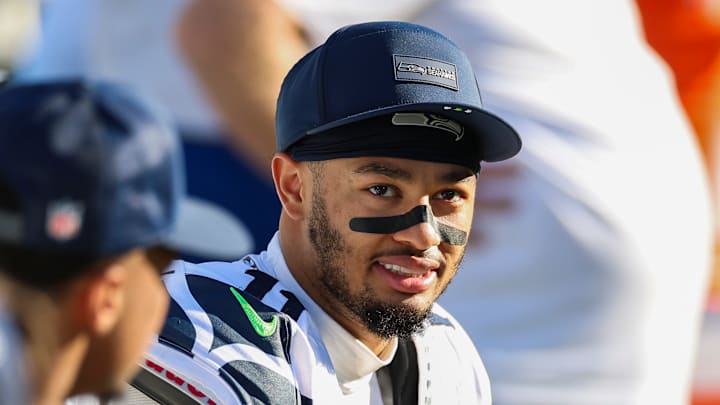
Through 12 games, the Seattle Seahawks have crafted one of the league’s most balanced, tough-minded résumés in 2025.
Sam Darnold has played the cleanest, most composed football of his career. The ground game, with Zach Charbonnet’s bruising style and Kenneth Walker’s explosive change-ups, has the flexibility to adapt to any environment, especially as winter sets in. And defensively, Seattle has bullied opponents at all three levels, leaning into a young, violent core that rarely loses the line of scrimmage.
But if Mike Macdonald's group is going to push into January and survive there, the defining factor won’t be Darnold’s steadiness or the front seven’s physicality; it will be whether Seattle can find someone -- anyone -- to consistently produce behind Jaxon Smith-Njigba.
Seattle Seahawks need to find an answer to this Jaxon Smith-Njigba issue
The aptly nicknamed JSN has been the league’s singular breakout star, the engine of the Seahawks’ offense, and one of the NFL’s most indefensible pass-catchers this fall. Through 12 games, he’s seen a ridiculous 107 targets, catching 82 for 1,336 yards and seven scores.
He’s already set a franchise single-season receiving record, and is pacing toward history with Calvin Johnson’s yardage mark (1,964 in 2012) and the league’s first 2,000-yard receiving season are both in legitimate reach.
But that level of dominance also paints a clear picture for playoff opponents: limit him, and Seattle’s passing game becomes dangerously thin.
And that’s why the question looming over Seattle isn’t about Darnold’s poise, or the run game’s viability. It’s about what happens if Smith-Njigba is bracketed, doubled, or simply slowed. What if he catches five for 50 and stays out of the end zone? What if he misses a series? Where does Seattle turn?
The first answer should be Cooper Kupp, who, in previous years, was the prototype of a WR1. But the production hasn’t matched the résumé: 34 targets, 438 yards, and long stretches where defenses aren’t forced to account for him as they once did.
His efficiency remains strong, yet Seattle hasn’t funneled volume his way, something that might need to change if teams tilt coverage hard toward Smith-Njigba.
Behind Kupp, the pair of young tight ends has quietly taken on significant responsibility. A.J. Barner, with 44 targets and 37 receptions, has been a trusted chain-mover and a reliable middle-of-the-field option for Darnold. His catch rate is outstanding, and his physicality after the catch fits Seattle’s offensive identity.
Then there's Elijah Arroyo, a second-round pick from Miami who has flashed real upside with 15 receptions on just 23 targets. He’s fluid, alignment versatile, and gives Seattle a vertical seam threat that they've lacked for years.
But, neither player scares anyone.
For Seattle, the fact remains that one -- or more -- of those targets has to become a dependable second pillar in the passing game. Because, as talented as JSN is, playoff defenses will do everything possible to force Darnold elsewhere in his progression.
 Add us as a preferred source on Google