

Now that Super Bowl LX is in the books, fans of the Seattle Seahawks and New England Patriots can finally turn their attention to what fans of the other 30 NFL teams have been doing since their teams were eliminated. The two major roster-building events of the offseason are rapidly approaching.
Free agency opens in a little over a month, and then the NFL draft takes place about six weeks after that. Some NFL rosters will change dramatically.
Seattle fans are well aware that John Schneider added two players in last year’s draft that played a vital role in Sunday’s big game. In the first two rounds, the Hawks’ GM chose starting left guard Grey Zabel and do-everything defensive back Nick Emmanwori.
He acquired several other players who could play bigger roles down the road, but even if Zabel and Emmanwori turn out to be the only two major contributors, it will still be a decent draft. Teams have to hit on their early-round picks. Finding a late-round gem is gravy. The top several picks must live up to their pedigree, or an NFL team cannot maintain long-term success.
Seattle Seahawks get a lot of potential in latest mock draft
That’s one reason why the latest mock draft from ESPN’s Matt Miller is so interesting. With the Senior Bowl in the books, scouts are gathering a lot more significant information on a wider range of prospects. Miller was therefore able to move beyond the standard “first-round-only” format of most mocks up til now and expand into the second round.
Seattle has each of its native picks in rounds one and two. As favorites in the Super Bowl, that gives them the 32nd and 64th pick for mock draft purposes. So who did Miller give to Mike Macdonald to continue building on this year’s tremendous success?
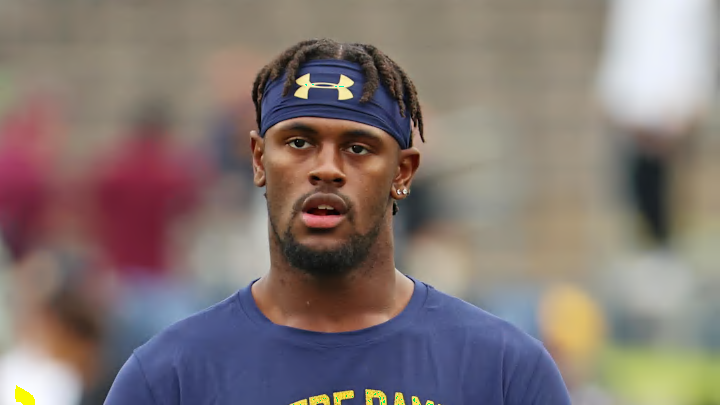
Round One: Malachi Fields, WR, Notre Dame
There is a growing consensus that by draft day, Fields will not still be on the board when Seattle chooses at the end of round one. But he was there for Miller, and this would appear to be a fairly easy pick to make.
Fields towers over most defensive backs. He actually plays bigger than his 6’4”, 218-pound frame would suggest. And he has been clocked at 4.5 in the 40. That’s not blazing speed, but it is quite good for someone who poses such size-based match-up problems.
After a few productive seasons at Virginia, Fields came to Notre Dame for his final college season and averaged 17.5 per-catch on 36 receptions. He showed very good hands and is a real weapon on contested balls and on fades in the red zone.
A high school quarterback, Fields also seems to have a good knack for running patterns against zones. For such a big man, he had a remarkable ability to get lost in the secondary’s soft spots. With veteran Cooper Kupp’s status unknown, a big receiver like Fields would seem to be an ideal complement for speedier wideouts like Jaxon Smith-Njigba, Tory Horton, and perhaps, Rashid Shaheed.
The thing that holds Fields back is his relative lack of explosiveness. If that 4.5 time is correct, he doesn’t seem to show it on the field. He’s not going to make a lot of people miss in the open field, nor is he going to run away from defenders.
But that’s not necessarily what Seattle needs at this point. The Seahawks have speed. Fields has a very high floor as a possession receiver with a potential high ceiling if the defense’s attention is focused elsewhere.
Round Two: Chase Bisontis, G, Texas A&M
There is a lot to like about Bisontis, but there is also a potential red flag.
Schneider got solid value by choosing a guard in the first round last year. Common wisdom says teams should not pick a guard that high because the position is easier to fill than, say, offensive tackle. But an elite player is an elite player, regardless of position. Grey Zabel may not be elite just yet, but he appears to be on his way.
Bisontis is generally considered the third or fourth best guard prospect in this year’s draft. He was the third guard taken in Miller’s mock. That could be a good value with the final pick in the second round.
Add to that the potential departure of right guard Anthony Bradford through free agency this year, and Bisonits would appear to be a good choice to pick up the slack. So what’s the red flag?
Bisontis doesn’t exactly look like Bradford on film, but he has similar strengths and weaknesses. He is a very good run blocker. He struggles in pass protection.
That is exactly what Seattle has had in Bradford throughout his time in Seattle. If he only had to run block, he would be a plus lineman. But he has to pass block as well, and that has caused problems.
Bisontis is a powerful straight-ahead mauler. He moves well, provided he is going forward. When he has to retreat or slide laterally, his lack of agility can show up. So Schneider has to determine if Bisontis would be an upgrade in the near future, or more of a lateral move from Bradford. If he is not ready to step into a prominent role as a starter within a year or two, is he worth a second-round pick?
Schneider has chosen ten offensive linemen in the last four drafts. Four of them are starting in the Super Bowl. If Bradford does, in fact, leave, would it be better to see what the team has in Bryce Cabeldue or Christian Haynes, or perhaps look to fill in with a veteran via free agency? That would leave the second pick free for a different position – perhaps edge rusher or cornerback.
Fortunately, regardless of what all the mock drafts propose, John Schneider has shown a pretty good eye for talent over the past few years. Chances are he’ll make a couple more good picks come draft time.
 Add us as a preferred source on Google