

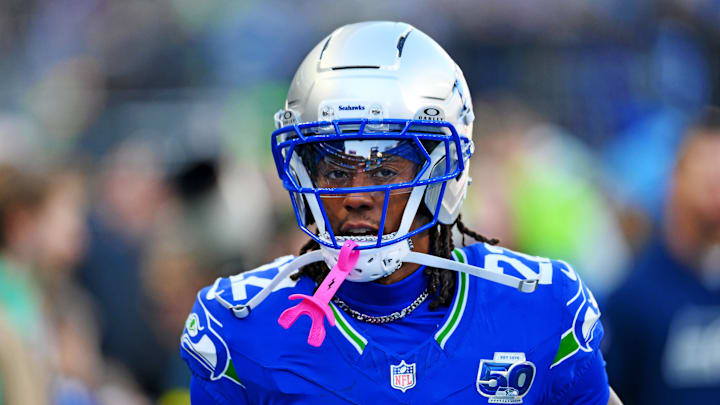
The Seattle Seahawks entered the offseason with the sixth-most available cap space. Even so, GM John Schneider was cost-conscious about almost every move he made. He prioritized keeping the guys he could keep, even if that meant letting go of fan favorites.
As frustrating as that may have been, Schneider thought about the long run and the 2027 offseason. That's why it was a bit of a head-scratcher to watch them spend that much money to bring back Rashid Shaheed, considering how little they used him.
Giving Shaheed a three-year, $51 million contract looked odd at the time. And, unless they finally start using him to the best of his capacities, this deal is going to age like a carton of milk out of the fridge.
The Seattle Seahawks overpaid to keep Rashid Shaheed in Seattle
Trading for Shaheed mid-season was an easy decision. He was familiar with Klint Kubiak's offense, and his talents were going to waste with the ever-struggling New Orleans Saints. The Seahawks needed a speedy playmaker, a big-play specialist, and a returner. On paper, Shaheed gave them all that at once.
Then, he was mostly a non-factor on offense. Outside of a couple of big catches, the Seahawks used him more as a decoy than an actual weapon. In his nine regular-season games in Seattle, he made four starts and hauled in 15 receptions on 26 targets for 188 yards and no scores.
He returned 13 punts for 210 yards and one touchdown and 14 kickoffs for 418 yards and another score, making more of an impact on special teams.
He looked like a no-brainer pickup for the Las Vegas Raiders, following Coach Kubiak again. Perhaps that's why the Seahawks felt compelled to spend more money than he would've gotten otherwise. John Schneider is a cerebral spender and a tough bargain, but everybody slips at least once.
Of course, this doesn't mean Shaheed isn't a good player or that he cannot make an impact in Seattle. He could have a prominent role in the passing game, with the aging Cooper Kupp taking a backseat and Shaheed being the Robin to Jaxon Smith-Njigba's Batman.
However, that raises another dilemma. Having him step up on offense should lead to a diminished role on special teams. As such, he'd be under even more pressure to deliver as a pass catcher. Otherwise, it's hard to justify spending that much money on someone who was supposed to contribute to two phases of the game.
The Seahawks' offense might look quite different with first-time playcaller Brian Fleury as offensive coordinator. But until they prove the doubters wrong, this will be the only blemish in an otherwise solid offseason by the reigning champions.
 Add us as a preferred source on Google