

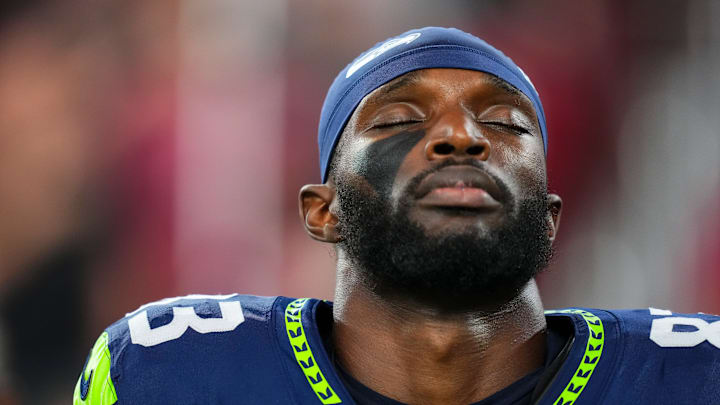
The first time Seattle Seahawks gunner Dareke Young ran downfield to cover a punt in the NFC conference championship game, he very nearly recovered a fumble that would have given his team the ball in the red zone.
Young had gotten downfield so fast that he was already standing a little bit behind Los Angeles Rams’ punt returner Xavier Smith when Smith muffed a catch. Smith was able to fall on the ball, thus averting disaster. At least temporarily.
Early in the third quarter, Young would get a second chance and end up making a game-changing play.
This time, he positioned himself directly in front of Smith. When the Ram return man stumbled backwards trying to field Michael Dickson’s high kick, Young pounced. One play later, Seattle scored a touchdown to go up 24-13. They would never relinquish the lead.
Seattle Seahawks special teams provide crucial edge in win over Rams
Coaches always preach about complementary football and winning in all three phases of the game. But sometimes it’s just talk. There is not much to choose between Seattle and Los Angeles on offense and defense. But there is an enormous difference on special teams.
Seahawks’ return man Rashid Shaheed made one of the biggest plays in the game the last time these teams met. His fourth quarter punt return for a touchdown in week 16 cut the Rams' lead from 16 to eight and allowed for a miraculous comeback. Without that play, it’s entirely possible Sunday’s game would have been played in Los Angeles instead of at Lumen Field.
Michael Dickson is an All-Pro punter, and kicker Jason Myers, despite some minor late-season struggles, was typically reliable on Sunday. And the less-heralded special teamers – players like Dareke Young – stepped up in a big way as well.
One of the hidden benefits of having Shaheed returning kicks is that opponents are willing to sacrifice field position in order to prevent huge plays. The Rams knew full-well what Seattle’s returner could do, so they simply refused to kick to him.
Five of Ethan Evans’ six kickoffs went into the end zone for touchbacks. Seattle started on the 35-yard line each time. Only once did he dare allow Shaheed to return the kick, and on that play, the Rams covered very well. Seattle may have been too shocked to execute with their normal efficiency.
Conversely, Myers put all six of his kickoffs into play. Eric Saubert was in on three tackles. Tyrice Knight had two. Mike Morris, Connor O’Toole, Brady Russell, Dareke Young, and his backup wide receiver teammate Jake Bobo each had one.
Did I mention that special team wiz Bobo was the player who scored the touchdown after Young’s fumble recovery? Pretty good sequence for a couple of special teamers.
On the night, Seattle’s average starting position after kickoffs was the 34-yard line, while the Rams started on the 27. That’s only six yards, but multiplied by six kickoffs in a razor-thin game, those thirty-six yards can make a difference.
Dickson out-punted Evans by three yards per kick. More hidden yardage. All five of his punts pinned the Rams inside their own 20-yard line. Given how well Matthew Stafford was throwing the ball, Seattle needed every one of those extra yards.
So it was not Rashid Shaheed and a thrilling kick return. It was not Jason Myers hitting a clutch 50-yard field goal with the game on the line. Seattle can do those things, but on Sunday, it was a different, more anonymous part of the special teams that contributed in a major way.
It was Dareke Young making a subtle adjustment on his coverage that led to a massive play. It was Brady Russell blowing up blocking schemes on every Rams’ return. It was Eric Saubert and Tyrice Knight cleaning up with multiple tackles.
It was a complete, three-phase game. Both offenses were dynamite. Both defenses struggled. And Seattle’s special teams were the difference.
Next up … Marcus Jones, Brenden Schooler, and an outstanding New England Patriots special teams group in the Super Bowl.
 Add us as a preferred source on Google