

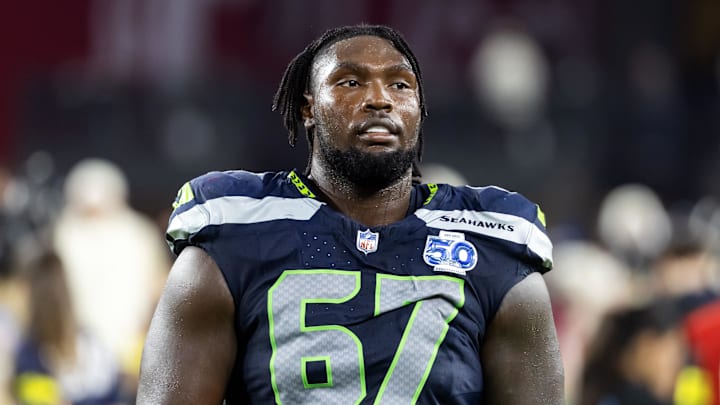
The Seattle Seahawks took the first step in locking up the young talent that has propelled them to the first overall seed in the NFC playoffs. It was announced last week by Ian Rapoport of NFL Network that Seattle and star left tackle Charles Cross had reached a deal on a four-year, $104.4 million contract extension.
The deal places Cross in the upper echelons of his position in terms of annual pay. At $26.1 million per year, he now ranks 4th among left tackles and 5th among all offensive tackles. The logical conclusion most people will come to is that his deal was benchmarked on Christian Darrisaw's extension before this season.
That extension pays Darrisaw $26 million per year. But when you compare the two, there aren't many similarities. Here is a look at their three-year production leading up to their contracts.
How does Seattle Seahawks left tackle Charles Cross's new contract stack up?
*Note this data is pulled from Pro Football Focus (subscription required).
Player | Age | Draft Round | Games | Snaps | Pressures Allowed | Pressure Rate Allowed | Sacks Allowed | True Pass Set Pressure Rate Allowed | PFF Run Block Grade |
|---|---|---|---|---|---|---|---|---|---|
Charles Cross (2023-2025) | 25.8 | 1 | 45 | 2,747 | 113 | 6.54% | 14 | 9.89% | 69.5 |
Christian Darrisaw (2024) | 25.2 | 1 | 40 | 2,487 | 73 | 4.51% | 16 | 7.06% | 78.4 |
Darrisaw has proven to be the better pass protector while also earning a better grade from the public grading site Pro Football Focus. By every public measure, Darrisaw is the better player.
A couple of things to note here. Given the timing of Cross's extension, it's safe to assume very little of his new money is coming in 2025. As such, I consider this extension, effectively, a 2026 deal. With an estimated salary cap of $305 million, Cross's $26.1 million APY represents 8.56% of the cap.
Comparatively, Darrisaw's $26 million APY is 9.31% of the $279.2 million salary cap this year. So, the Darrisaw deal isn't the greatest comp for Cross.
But looking through tackle contracts that have been signed since 2020, I did find an interesting comp that may have guided Cross' deal.
Player | Age | Draft Round | Games | Snaps | Pressures Allowed | Pressure Rate Allowed | Sacks Allowed | True Pass Set Pressure Rate Allowed | PFF Run Block Grade |
|---|---|---|---|---|---|---|---|---|---|
Charles Cross (2023-2025) | 25.8 | 1 | 45 | 2,747 | 113 | 6.54% | 14 | 9.89% | 69.5 |
Braden Smith (2018-2020) | 25.2 | 1 | 45 | 2,865 | 98 | 5.86% | 10 | 10.10% | 75.9 |
Smith's pressure rate allowed and run blocking grades are more aligned with Cross. Smith's four-year, $70 million extension in 2021 had an APY of $17.5 million. 2021 was an odd year for the salary cap as it dipped due to the impact of COVID-19 on league revenues in 2020.
Teams spent cash outside of their norms. As such, I treat that year's salary cap as the midpoint between 2020's $198.2 million and 2022's $208.2 million. Smith's APY was 8.61% of that number ($203.2 million).
8.61% of an estimated $305 million salary cap for 2026 is $26.25 million per year. That's just a hair off of what Cross signed for. It also places a greater context for how the Seahawks value Cross. His APY as a percent of cap (8.56%) would slot in as the 20th highest tackle contract signed since 2020 and 13th highest among active tackles.
The most significant difference between Smith and Cross is that Smith is a right tackle while Cross plays on the left side.
15 years ago, that would have made a significant difference, but the two positions are converging more of late as teams recognize they need high-level pass protection on both sides of the ball, and considering defenses are now moving their best pass rushers over the right tackle more.
But how does he compare to another left tackle with a similar profile? I found two left tackles with similar platform profiles over their platform years.
Player | Age | Draft Round | Games | Snaps | Pressures Allowed | Pressure Rate Allowed | Sacks Allowed | True Pass Set Pressure Rate Allowed | PFF Run Block Grade |
|---|---|---|---|---|---|---|---|---|---|
Charles Cross (2025) | 25.8 | 1 | 14 | 821 | 24 | 5.33% | 2 | 6.45% | 66.7 |
Kolton Miller (2020) | 26.0 | 1 | 14 | 961 | 31 | 5.26% | 2 | 8.07% | 55.4 |
Taylor Decker (2019) | 26.0 | 1 | 15 | 1,017 | 34 | 5.21% | 6 | 8.25% | 69.1 |
All three are former first-rounders who were right around their 26th birthday at the start of the league year following the signing of their deals. Their pressure rates allowed are near-identical, but Cross was much better at pressure in pass-obvious situations. And as a run blocker, he grades out as on the higher end of the spectrum of the three.
Miller's deal in 2021 had an APY equal to 8.86% of the salary cap, while Decker's was for 7.52%. Applied to an estimated $305 million cap would create a range of $23 million - $27 million, with an average resting right at $25 million.
We are still waiting to hear additional details around the contract beyond his APY and his $40.5 million cash flow in the first 12 months. But on the surface, while the APY seems huge, it's really a fair deal for the Seahawks as well as Cross himself.
 Add us as a preferred source on Google