

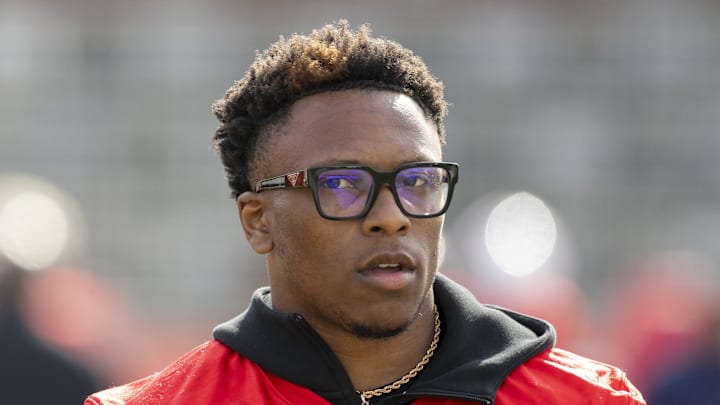
Seattle Seahawks' John Schneider has displayed the discipline of a two-time Super Bowl-winning general manager this offseason. He had money to spend but refused to enter a bidding war for Super Bowl MVP Kenneth Walker III. The same applies to edge rusher Boye Mafe.
Schneider appears to have prioritized the steadier Josh Jobe over the mercurial Riq Woolen at cornerback, and figured he had stockpiled enough quality at safety to allow Coby Bryant to walk.
This may be why the Seattle Seahawks have won two Super Bowls with entirely different rosters under Schneider’s watch.
Seattle Seahawks lay the groundwork for long-term success in the 2026 draft
He also retained some key depth players like Josh Jones and Jake Bobo, but clearly, the GM has some work to do to offset the losses he suffered. That process began with those free agency decisions and will continue in next month’s draft. With only four picks, he will need to be creative. Today, we’ll look at what an aggressive trade-back strategy might look like.
Seattle is in a good position to trade back this year. Though they do not have a ton of draft capital, they do have picks in each of the first three rounds. Those will attract attention. This year, there is a glut of similarly-rated talent in the middle of the draft, so moving back on day two or three may not end up costing you the player you want.
Early projections suggest that next year will provide a deeper talent pool, so picking up additional 2027 picks could prove very beneficial. Schneider is already playing the compensatory pick game for 2027 by not gobbling up many free agents from other teams this year.
So I went into this draft looking to move back. And I did, with a vengeance. Here are the four trades I made:
Trade 1: I traded picks 32 and 188 (first and sixth round) for pick number 48, and second and third round selections in the 2027 draft with Atlanta.
Trade 2: Atlanta came calling again. I traded the 64th pick for picks number 79 and 122, along with the Falcons' sixth-round pick in 2027.
Trade 3: I traded pick 79 to Baltimore for picks 80 and 154.
Trade 4: I dealt my native third-round pick – number 96 – to Denver for pick 108 and the Broncos’ fourth-rounder in ’27.
I ended up with five picks in this year’s draft – none lower than 154 – and four extra picks next year.
Now, as for this year’s picks….
Round 2, pick 48: Colton Hood, CB, Tennessee
Let me just say I can only play the cards I am dealt. Sometimes, you get dealt four aces. There’s no way I expected Hood – a premier cornerback talent – to still be on the board at this point. But he was so I grabbed him. Most analysts have the 6’0”, 193-pound corner with excellent speed to go late first or early second round.
He fits ideally with Mike Macdonald’s system – able to play a perimeter zone position with advanced skills and plenty of room to grow. Just as a note – there were other players I would have been happy with in this spot who were in fact available, but if I can trade back and still get Hood, that’s a slam dunk.
Round 3, pick 80: R. Mason Thomas, Edge, Oklahoma
I rejected a few other offers to move back a little farther at this pick because I didn’t want to risk losing Thomas. He may not be a Boye Mafe clone – Thomas does not have the same size that Seattle has valued in its edge players.
But he is a playmaker, pure and simple. Great speed and the ability to turn a corner with the likes of Reuben Bain and David Bailey, edges who will go in the top ten. The concern is whether Thomas has the size to be anything more than a pass-rush specialist. I’m betting he can, and if I’m wrong, he should still be excellent in that more limited role.
Round 4, pick 108: Kaelon Black, RB, Indiana
Black shared carries with Roman Hemby on Indiana’s national championship team. I think he is a more explosive back than Hemby, while still having the ability to get tough yards in the middle of the field. Black is by no means a Kenneth Walker replacement.
He doesn’t have the speed or the pass-catching ability. But the speed is decent, and he is just a very solid runner who can help share the load with Zach Charbonnet in a backfield-by-committee.
Round 4, pick 122: Matt Gulbin, IOL, Michigan State
Gulbin is not exactly the fluid athlete that teams want in a lineman. He is just a very tough, versatile interior lineman who delivers exactly what NFL teams need. He has excellent pass-blocking technique along with solid power as a run blocker.
Plenty of experience at all three interior line spots against elite Big-10 competition. He was the team captain for the Spartans and seems to play above his athletic profile. At the very least, he provides strong, versatile depth.
Round 5, pick 154: Deion Burks, WR, Oklahoma
Seattle is not about to find another Jaxon Smith-Njigba walking through the door, but Burks, in some ways, reminds me of a bargain-rate JSN. He lacks elite size, but he makes up for it in other ways. He runs very good routes at all three levels.
He has surprising strength for a 5’10”, 180-pound receiver. And his speed is no joke. He is a legit burner. On top of that, he has always shown very good hands. Getting a talent like that to play behind JSN is very intriguing. I think Burks has a higher ceiling than is typically assumed.
So, to recap – Hood challenges for a starting spot immediately, while the others provide talented depth. Plus, I’ve got four extra picks next year, including a couple on day two. Even with some key free agency losses, Seattle has an elite roster. This draft bolsters it in some important spots and lays the groundwork for a massive haul in 2027.
 Add us as a preferred source on Google